
Nvidia (NVDA): The Moat Is Software, Not Just Chips
The word people reach for with Nvidia is “chip designer,” and I think that undersells it. Second-quarter fiscal 2027 revenue was $96.2 billion, up 106% from a year earlier, and Data Center alone brought in $89.0 billion of it, up 117%, according to Nvidia’s own results release (segment detail is on Nvidia’s financials page). Nobody serious argues demand is missing anymore. The real question is how much of that revenue is protected from competition, and for how long, which is a harder question than “will it grow.”
How big it has gotten
Gross margin in the quarter was 75.0%, and management guided the next quarter to about $108 billion, plus or minus 2%, with margin near 74%. The company also said the outlook assumes zero Data Center compute revenue from China, which is worth sitting with for a second. A company can guide to $108 billion and treat an entire country’s worth of AI chip demand as a rounding error it does not need. That tells me more about the size of the non-China order book than any single customer name would.
Revenue has not grown in a straight line so much as it has stepped up in jumps. Fiscal 2024 revenue was $60.9 billion, more than doubling the prior year. Fiscal 2025 came in at $130.5 billion, another leap. Fiscal 2026 finished at $215.9 billion. Three years, each one roughly doubling the last. That kind of compounding rarely continues on schedule, and I am not betting it repeats. It is simply the base the current multiple is being measured against.
CUDA and two decades of lock-in
The first piece of the moat is software. Nvidia said this year that six million developers now build on CUDA, its programming platform, twenty years after the company started it, a milestone it marked at its own developer conference. That is not a glamorous number. It does not show up in a product photo. But it is the reason customers stay: years spent tuning code to one architecture cost real engineering time to move, and most AI teams would rather spend that time shipping models than porting them.
A moat built on switching cost is different from one built on being the only supplier. Custom silicon from Google, Amazon, and Microsoft, is real and growing, and I would not wave it away. What those chips are not yet doing at scale is displacing the software layer that trained a generation of AI engineers to write CUDA first.
The network is the product, too
Where Nvidia’s edge gets harder to copy is in the plumbing. NVLink connects GPUs inside a server, and InfiniBand and Ethernet gear connects servers into a cluster. A single fast chip matters less than whether a few thousand of them can act like one machine during training, and that is a systems problem as much as a chip problem. A rival could, in principle, build a GPU that matches Nvidia’s on paper. Matching the interconnect stack that makes ten thousand of them behave coherently is a different and slower project.
I read the growing weight of networking revenue inside the Compute and Networking segment, which was 91.8% of total revenue this quarter, as the clearest sign of where the real lock-in sits. Customers are not buying chips one at a time. They are buying racks, and racks are harder to unwind than a single component order.
Sovereign buyers are a newer source of demand
Governments have become direct buyers rather than passive observers of the AI buildout, negotiating chip allocations the way they once negotiated defense contracts. I would treat this as a genuine new demand channel rather than noise, but I also would not size a position around it, because sovereign orders are lumpy and politically contingent in a way that enterprise cloud spending is not. A single export policy change can move that line item by a wide margin in either direction.
What the bears get right
The bear case has three parts that hold up under scrutiny. Custom chips from the largest cloud customers reduce Nvidia’s share of their own future spending, even if they do not replace it outright. A pullback in AI capital spending by any of the four or five customers that matter most would show up fast, and AMD’s own case for taking share as the second source of AI compute is the clearest evidence that Nvidia is not the only company customers want to hear from. Competitors, AMD chief among them, are not standing still on either chips or software tooling.
There is a fourth data point I would add that the original bear case did not have: the quant score on this stock moved from a B in early September to a C by mid-month and has held there. That is a small thing on its own, and short interest is still low at 1.2% of the float, so it is not a crowded short. But a model-driven downgrade arriving in the same month analysts kept raising price targets is the kind of divergence I want to watch rather than dismiss.
The circular money question
There is a version of the bear case that does not depend on chips or software at all. Nvidia has been taking equity stakes in some of the AI companies that turn around and buy its GPUs, and outside trackers put the disclosed value of those stakes at roughly $99 billion as of early September. Critics call this circular: Nvidia funds a customer, the customer spends the money on Nvidia hardware, and both sides get to point at growing numbers. I think that framing overstates the mechanism. Equity stakes are a rounding error next to $96 billion of quarterly revenue from thousands of customers, most of whom never received a dollar of Nvidia investment.
What I would actually worry about is concentration, not circularity. A handful of hyperscalers and a growing list of well-funded AI labs account for most of the Data Center number, and if two or three of them decided in the same quarter to slow their build-out, the reported growth rate would break well before the equity-stake story mattered at all. That is the more mundane risk, and the one I keep coming back to.
Margins near 75% still say something
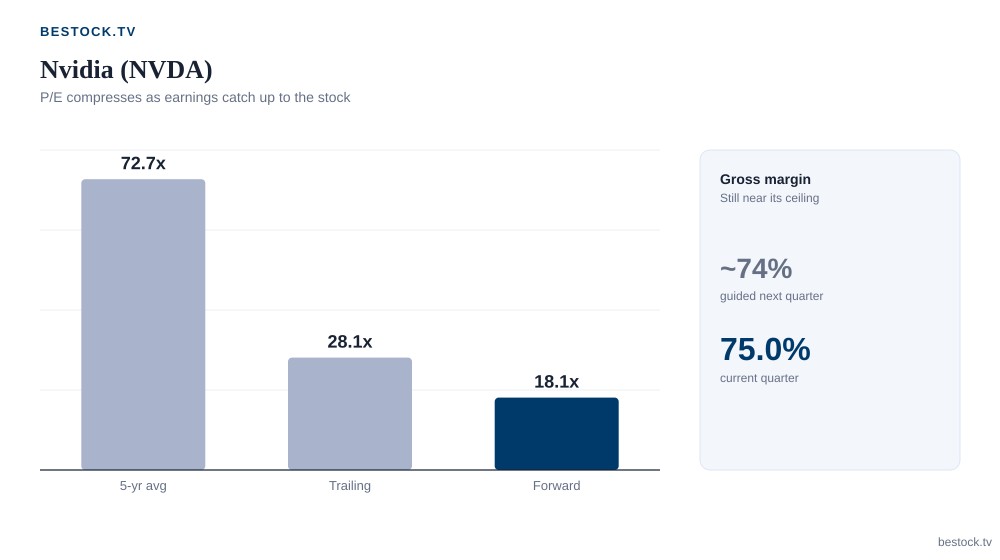
A company selling into a capacity-constrained market at 75% gross margin is not pricing like a commodity supplier. If GPUs were a fungible product, competition would have compressed that margin already. It has not, and the guided margin for next quarter, near 74%, is barely lower. I would treat any real slide in that number, not a one-point wobble but a sustained move toward the high 60s, as the first hard evidence that the moat is thinner than the revenue growth suggests.
The trailing P/E has fallen from a five-year average of 72.7 to 28.1 now, because earnings have grown faster than the stock price for several quarters running. The forward multiple is 18.1. That compression looks like the market pricing in slower growth ahead, not doubt about the current quarter, and those are different things to underwrite.
| Fiscal year | Revenue | Growth |
|---|---|---|
| 2023 | $27.0 billion | flat |
| 2024 | $60.9 billion | 126% |
| 2025 | $130.5 billion | 114% |
| 2026 | $215.9 billion | 65% |
What would change my mind fastest
The single number I would watch is the split between chip revenue and networking revenue inside that Compute and Networking segment. If networking keeps growing faster than raw GPU shipments, customers are buying whole clusters and the moat is holding. If chip sales start outrunning networking sales, buyers are increasingly treating Nvidia’s silicon as a component to slot into someone else’s system, and the pricing power that supports a 75% margin gets harder to defend.
My other check is the China line in the next two guidance calls. Management is currently assuming zero Data Center compute revenue from that market. Any reopening, even partial, would be pure upside to a number that already assumes the worst case, and a company guiding conservatively on a known unknown is a better setup than one that has quietly priced in an optimistic outcome.
How I would size a position here
At $5,356.7 billion in market value and a stock that moved +8.7% on its last earnings day against an average move closer to 4.8%, this is not a name where a full position belongs in an account that cannot absorb a double-digit single-day swing. I wrote a longer piece on sizing positions once beta climbs above 2, and Nvidia’s earnings-day volatility puts it in that category even when the underlying growth story is intact. Average analyst targets sit at $324, all thirty covering analysts rate it Buy, and none rate it Sell or Hold, which tells me the sell side has mostly stopped debating the near-term numbers and started debating how long the cycle runs.
For a side-by-side against the company most often named as the alternative, Nvidia and AMD compared on growth, price, and payout is the piece I would read next, since the bear case for one is close to the bull case for the other.
Analysis and opinion only, not investment advice. Figures come from NVIDIA‘s second-quarter fiscal 2027 results release and its SEC filings; valuation multiples are approximate and were checked on September 18, 2026.