
Citigroup (C) at 1.2 Times Book Value: Is It Still Cheap?
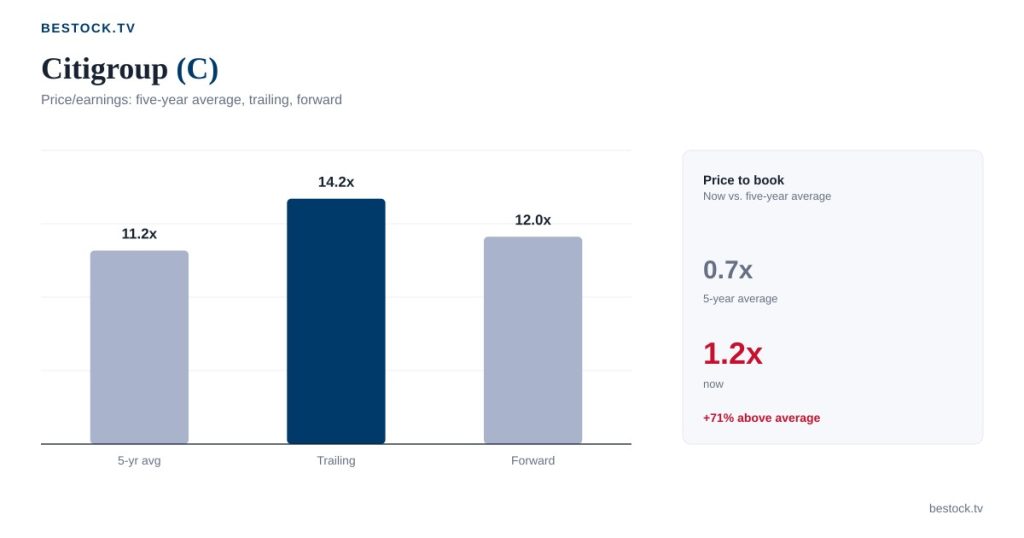
Citigroup trades at 1.2 times book value today. Its five-year average is 0.7. For most of the last decade the bank sat below the value of its own accounting equity, and the market treated that as fair, because the company earned too little on that equity to deserve more. So the interesting question now is what has to be true for 1.2 to be a reasonable price, and whether $131.77 a share, roughly where the stock sits as I write this, still leaves room after a rise of 44% from the 52-week low of $92.
My answer is that Citigroup is no longer the screaming bargain it was, but it is still priced for a result that is easier to reach than the price suggests. The stock does not need a heroic quarter. It needs the earnings estimates for the next year to be roughly right, and it needs a normal credit cycle to stay normal. That is a narrower bet than the old value-trap debate, and it deserves a narrower discussion.
What the re-rating already paid
Start with what has happened. A price of $131.77 is 10.5% below the 52-week high of $147 and 44% above the low. Market value is about $221.0 billion. Trailing earnings per share are $9.28, which puts the stock at 14.2 times trailing earnings against a five-year average of 11.2. On forward estimates of $11.02 the multiple drops to 12.0, still a touch above that 11.2 average. You can see the full trend on Citigroup’s financials page.
Read those numbers together. The market has already stopped paying a distressed multiple. If Citigroup traded at its five-year average earnings multiple on trailing profit, the price would be near $104, and on forward estimates near $123. Neither is far below today’s quote, which tells me the easy part of the re-rating is behind us. The stock is not being carried by a multiple that could snap back to some historic low. It is being carried by the belief that earnings keep rising.
That belief is not unreasonable. The gap between 14.2 trailing and 12.0 forward implies analysts expect earnings per share to grow about 19% over the next year. I treat that as a hurdle rather than a forecast, because bank estimates get revised in both directions, and a single quarter of higher loan-loss provisions can erase a large part of that growth.
Revenue up 14% in three years, profit up less
The income statement supports a turnaround story, with limits. Revenue was $85.2 billion in 2025, up from $80.7 billion in 2024, $78.1 billion in 2023 and $74.5 billion in 2022. That is about 14% growth over three years, or a bit under 5% a year, which is respectable for a bank this size but far from explosive.
Net income tells a slightly less exciting story. Profit was $14.5 billion against $12.8 billion the year before, a gain of roughly 13%, on a net margin of 17%. Profit grew a little slower than revenue in the latest year, and a value argument built only on “margins are rising” does not hold up on these numbers alone. The improvement is real, but it is gradual.
The latest quarter looks stronger. Revenue came in at $24.8 billion, up 14% from the same quarter a year earlier and flat against the prior quarter. Annualized, that is a run rate of about $99.1 billion, well above the full-year $85.2 billion. If the run rate holds, the 2025 revenue base will look small in hindsight. If it fades, as trading-driven quarters often do, the year-over-year growth was a good stretch rather than a new level. I lean toward the second reading for part of it, because a bank of this size has large markets businesses, and those never repeat on schedule.
Since the restructuring is the heart of the bull case, I would point to the public record on that: the bank has spent years selling consumer franchises abroad and simplifying its structure under CEO Jane Fraser, and the company’s own investor materials at citigroup.com lay out the target returns and the timetable. I have deliberately not repeated the percentage claims about how far along the program is, because those are management’s characterizations and I could not verify them independently. What I can verify is the outcome in the reported numbers above, and the outcome is a bank that grows, earns a 17% net margin and trades at a premium to where it used to.
Book value is the anchor that matters
Banks are priced off tangible and book value more than off any earnings multiple, and here the picture is clearest. At 1.2 times book against a 0.7 average, the market pays about 70% more per dollar of equity than it did on average over five years. That premium is justified only if returns on that equity are decent and durable, because a bank that earns its cost of equity deserves roughly one times book, and one that earns clearly more deserves more.
Here is a rough way to test it. Book value per share is around $110 if I back it out of the price and the 1.2 multiple. Trailing earnings of $9.28 on $110 of book is a return of about 8.4%. On forward estimates of $11.02, the return rises to about 10%. Those are back-of-the-envelope figures, and they use total book rather than tangible common equity, which is the measure management targets and which produces a higher percentage. Still, a return around 8% to 10% on book does not, by itself, justify a premium to book. It justifies roughly the current valuation only if the return keeps climbing.
That is why I do not call the stock cheap on book. I call it fairly priced for a bank in the middle of proving that its returns can rise, and I think the market is correct to demand proof. For a comparison of how the big four banks stack up on returns and capital return this year, my side-by-side table of second-quarter results puts Citigroup next to JPMorgan, Bank of America and Wells Fargo on the same basis.
The valuation table
| Metric | Value | Reference point |
|---|---|---|
| Price | $131.77 | 52-week range $92 to $147 |
| P/E, trailing | 14.2 | five-year average 11.2 |
| P/E, forward | 12.0 | implies 19% EPS growth |
| Price to book | 1.2 | five-year average 0.7 |
| Price to sales | 2.5 | five-year average 1.6 |
| Dividend yield | 1.82% | $2.40 per share over the last twelve months |
| Analyst target, average | $158 | range $142 to $176, 14 analysts |
The price-to-sales line deserves a mention because it shows how much of the re-rating has come from the market. A multiple of 2.5 against a 1.6 average is a 56% premium, and revenue has not grown 56%. The rest is a change in how investors regard each dollar of Citigroup revenue, which is a change in trust, and trust is the part that can be withdrawn quickly.
What Wall Street targets and the quant model say
The 14 analysts who cover the stock have an average target of $158, about 20% above the current price, with a low of $142 (8% upside) and a high of $176 (34% upside). 79% of them rate it a buy. Even the most cautious analyst in that group sees the price a bit higher, and that is what makes me a little wary. A consensus that has no bears among target prices has usually already moved the stock to the point where new information is needed to keep it going.
Our own quant grade for Citigroup has improved from a D to a C, which is a mild endorsement of the direction and not an endorsement of the price. Short interest is low at 1.6% of shares, so nobody is betting heavily against the stock either. Sentiment is the quiet kind: broadly positive, not crowded.
The dividend matters more here than the yield suggests. At $2.40 a share the payout is about 26% of trailing earnings, which leaves plenty of earnings for buybacks and for capital that regulators require the bank to hold. A yield of 1.82% will not draw income investors, and my screen of dividend stocks points elsewhere for that purpose. Citigroup is a total-return story where retained and returned capital both lift the per-share result.
Earnings-day risk is real
The last report, on 2026-07-14, was followed by a move of -5.3% in the stock, and the average post-earnings move has been 3.8%. That is a volatility measure, not a forecast, and it says that a bank stock that has already run tends to react sharply to small disappointments. A holder should assume the next report can move the price about 4% either way and plan the position size around that, rather than around a target.
What would prove me wrong
I could be wrong in two directions. The first is that I am too cautious: if the forward EPS of $11.02 proves conservative and the bank delivers well above it, the stock at 12.0 times forward earnings will look cheap in hindsight, because even a five-year-average multiple of 11.2 on, say, $12 of earnings gives around $134, and a multiple that keeps expanding would give far more. Nothing in the numbers rules that out.
The second is the opposite and the one that worries me more. Credit is the swing factor for every large bank, and Citigroup has a large card and lending book. A weaker consumer would raise provisions quickly, and the forward EPS estimate would fall. That kind of shock does not care about how much the restructuring has improved efficiency. I did the rate-sensitivity side of this in my piece on bank net interest margins after the rate-cut turn, and the short version is that falling rates help funding costs and hurt asset yields, so the two forces need to be watched together.
For a comparison from outside banking, PayPal’s turnaround offers a useful parallel: a restructuring can improve margins for a few quarters and still leave the stock priced for more. I would hold Citigroup to the same standard.
The bar the October quarter has to clear
If the usual reporting pattern holds, the next report lands in mid-October. My threshold is simple. Revenue near or above the $24.8 billion of the latest quarter, with earnings tracking toward the $11.02 forward estimate, keeps the case intact and makes $158 a fair target for the year ahead. A quarter that falls short of that pace while provisions rise would make the current 12.0 forward multiple look too high, and I would want to see the price closer to $115 to $120, about 12x trailing earnings, before calling it cheap again.
Today it sits in between. It is a reasonable holding for someone who already understands the risk, and not a stock I would chase for its discount, because the discount has mostly closed.
Analysis and opinion only, not investment advice. Figures come from Citigroup’s filings on SEC EDGAR and its investor site, plus market data; valuation multiples are approximate and were checked on September 22, 2026.