The Semiconductor Cycle Isn’t Dead, It’s Hiding Behind AI CapEx
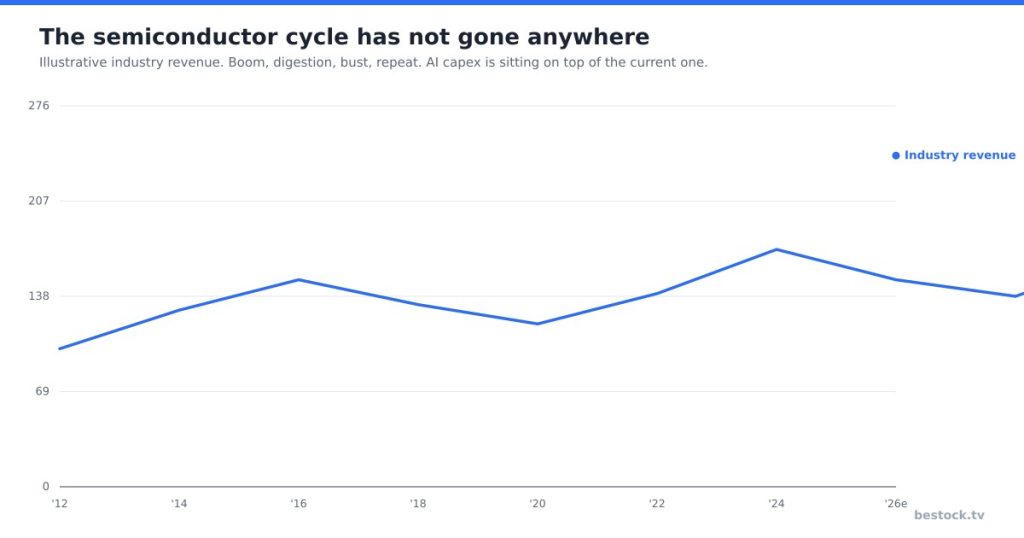
Four companies now guide to something like $725 billion combined in 2026 capital spending on AI infrastructure, up from roughly $410 billion in 2025. That single jump is doing more to shape semiconductor stocks this year than any product cycle, and it is currently burying a habit the industry has never managed to break.
Every few years someone announces that chips have stopped being cyclical. Demand is structural now, the argument goes, because silicon is in everything. I heard it in 2000. I heard it again in 2021. Both times the cycle turned up about eighteen months later and did what it always does.
My thesis is narrower than either claim: the cycle has not disappeared, it has been buried under hyperscaler capex, and the part of the industry with the least pricing power, commodity memory, will be the first place the burying stops being visible. If you hold semiconductor exposure, the question worth answering is which slice of it is actually cushioned against that and which slice is just enjoying unusually good weather.
Why chip demand always overshoots
The mechanism is a timing mismatch, not a mystery. When a chip type gets scarce, customers over-order to protect their own production lines, sometimes placing the same order with two suppliers just to be safe. Manufacturers respond by committing new capacity. A leading-edge fab does not arrive quickly; it takes years and an enormous amount of capital, and by the time the new lines are running, the panic that justified them has usually passed. The duplicate orders get canceled, supply outruns real demand, prices fall, and capital spending gets cut, which quietly sets up the next shortage. Nobody designed this pattern and nobody has repealed it. It is what happens when long lead times meet volatile ordering behavior.
What makes this particular cycle harder to read than the last one is that the current demand driver is not a product refresh with a known shelf life, like a phone launch or a PC upgrade wave. It is data center construction tied to a technology, generative AI, whose economics are still being worked out in public, quarter by quarter, on the earnings calls of the companies buying the chips. That is a slower-moving demand signal than a consumer product cycle, which is part of why the current upswing has already run longer than a typical shortage-driven one without an obvious end date attached to it.
Three layers absorb the cycle differently
Memory is the most exposed part of the stack. DRAM and NAND behave like commodities: a handful of producers, an interchangeable product, and price swings that can be severe from peak to trough. When a memory maker posts unusually fat margins, that is usually closer to a top than a beginning. AI has added a genuine new source of demand through high-bandwidth memory for accelerators, and that has propped up pricing in that specific niche, but the broader memory market still trades on the old, rough rhythm.
Foundry sits one layer up and is cushioned rather than immune. The company making the most advanced logic chips has customers who sign multi-year agreements and prepay for capacity, because there is nowhere else to go for the newest process node. Demand swings still show up in utilization rates, but they do not gut the business the way a memory downturn does. This is also the layer where the AI buildout has the most durable footing, since the chips at the center of it need the newest nodes to run. I went through the design side of that demand in detail in my Nvidia and AMD comparison, and the competitive case for the challenger specifically in a separate rating.
Equipment makers, the companies selling the lithography, deposition and etch tools that build the fabs, feel the cycle with a lag. Their order books move with fab capital budgets, not end demand directly. When everyone is expanding at once, as they are now, their backlogs fill up fast. When capex gets cut, the slowdown shows up in their bookings a few quarters later, after it has already hit the chipmakers. Right now those backlogs are full because of AI-driven construction. The open question is what happens to them if hyperscaler spending merely slows its rate of growth, let alone shrinks.
What the capex numbers actually show
The scale of the current AI buildout is easiest to see in one place: the capital budgets of the four companies actually paying for the data centers.
| Company | 2026 capex guidance | 2025 spending |
|---|---|---|
| Amazon | about $200 billion | about $125 billion |
| Alphabet | about $205 billion | about $91 billion |
| Microsoft | about $190 billion (fiscal 2026) | about $90 billion |
| Meta | $135 billion to $145 billion | about $72 billion |
| Combined | roughly $725 billion | roughly $410 billion |
That is a roughly 77% increase in one year from four buyers. On the supply side, equipment makers are describing the same thing in their own words: Applied Materials, one of the largest suppliers of the deposition and etch tools that build a fab, has pointed to AI-driven data center construction as the main driver of its order backlog, the kind of primary-source detail worth reading directly in its SEC filings rather than through a secondhand summary. Two data points, both pointing the same direction: this is a demand surge concentrated in one customer category, not a broad-based recovery across every chip end market.
Signals I use instead of a single gauge
There is no one number that tells you where the cycle sits, so I watch a handful of things move together. Lead times stretching and then suddenly collapsing is a classic sign of a top. Inventory days climbing across several companies in the same supply chain at the same time, not just one, is another. Management language shifting from confident phrases about demand visibility to euphemisms like “a period of digestion” is a third, and it is usually the last one to show up.
One signal I used to rely on no longer exists in public form. SEMI stopped publishing the industry’s book-to-bill ratio back in 2017, so anyone still citing that number is working from something stale. What is left in its place is backlog commentary on earnings calls and the inventory-days trend across the supply chain, which is noisier but still useful if you track it every quarter rather than glancing at it once.
A fourth thing I watch, less precise but still useful, is how management teams talk about capacity utilization on earnings calls. “Fully booked through next year” is a very different sentence from “we expect to add capacity ahead of confirmed orders,” and companies tend to shift from the first phrasing to the second well before the numbers themselves turn, because that is the moment they start hedging their own forecasts in public.
Right now, most of those readings still point up for the AI-exposed names and are mixed to soft everywhere else. Autos and industrial chips already went through their own mini-downturn over the past two years. Consumer-facing silicon has been weak. It is really the data center segment alone holding the industry’s aggregate numbers up, and a cycle carried by one buyer category is a narrower, more fragile thing than the headline growth rate suggests.
Where I would concentrate exposure
I would rather own the layer that gets cushioned than the layer that gets crushed, which points toward leading-edge foundry and the design companies with real architectural moats over pure memory. The sovereign and hyperscaler demand behind all of it is something I covered separately in my write-up on where that spending is going.
I would rather split exposure across at least two of the three layers than put it all in one, precisely because the layers do not turn at the same time. Equipment lags the chipmakers by design, so a portfolio concentrated only in equipment names is a portfolio betting that the lag holds up through the next several quarters, which is a narrower bet than it looks from the outside.
The mistake I am trying to avoid is treating the sector as one trade. It is not. It is a stack of businesses with sharply different exposure to the same cycle, and the AI spending making all of them look strong right now is not distributed evenly across that stack. Line the major names up on valuation and recent price behavior and the spread between them is wide, wider than in most sectors, and it is wide for reasons that matter: memory, foundry and equipment are three different bets wearing the same sector label.
The counter-case that would prove me wrong
Here is the specific thing that would change my mind: if two or more of the four hyperscalers in the table above cut their already-issued 2027 capex guidance by a meaningful amount, say more than 15%, before a single AI product cycle has visibly slowed, that would suggest the spending itself is not driven by end demand and could unwind faster than the fab and equipment order books assume. I do not think that is the base case. I also cannot rule it out, and that is the honest uncertainty sitting underneath this whole argument: nobody, including the companies writing the checks, has a great track record forecasting their own capex two years out.
The AI investment wave is real and probably has years left in it. That does not repeal the semiconductor cycle; it postpones the visible part of it and concentrates the risk into whichever quarter data center spending first disappoints relative to guidance. I keep positions in this group sized for their betas rather than treated as one uniform basket, and I pay closer attention to lead-time and inventory commentary than to the headline growth numbers, because that is where a turn shows up first, one company at a time, long before it reaches a headline.
Analysis and opinion only, not investment advice. Figures on hyperscaler capital spending come from company guidance as compiled by CNBC, and equipment-market commentary comes from Applied Materials’ SEC filings; both were checked on September 23, 2026, and are subject to revision as the year plays out.
Related Reading
 CVS
CVS
CVS Stock at 13.6 Times Forward Earnings: Is the Estimate Stale?
CVS Health trades at 23.4 times trailing earnings and 13.6 times forward earnings, and the raised 2026 guidanc…
 News
News
Target Stock: Traffic Is Up 3.6%, Margins Have Not Followed
Target's comparable traffic grew 3.6% last quarter and the stock has nearly doubled from its low. At 16.4 time…
 News
News
Five Footnotes I Read Before I Trust a Balance Sheet
A balance sheet shows totals; the notes show how they were built. Here are the five footnotes I open first, wh…