
UPS at a 7% Yield: Priced for a Problem or Priced for Fear?
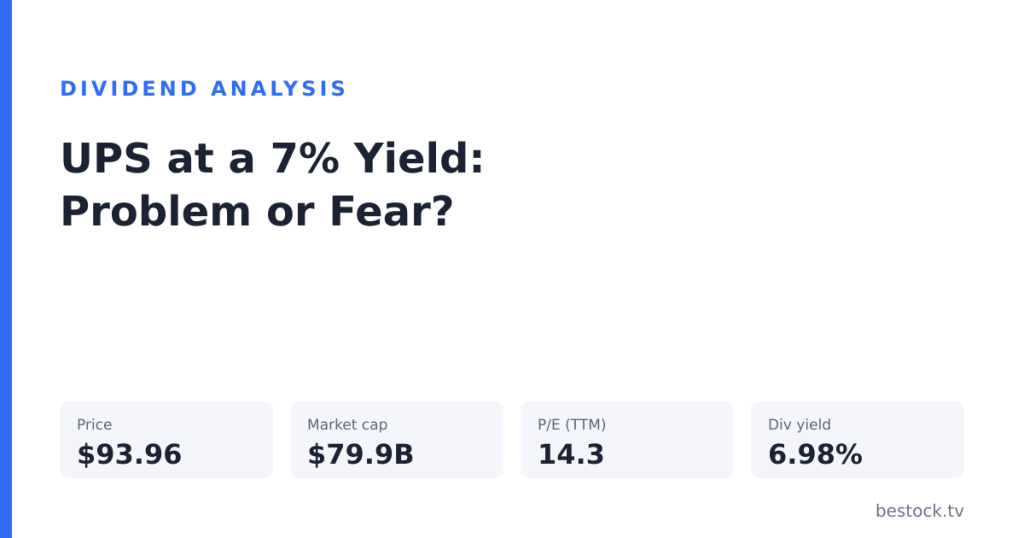
United Parcel Service pays out almost seven dollars for every hundred you put into the stock right now. A 6.98% dividend yield on a stock trading at $93.96 isn’t a number the market hands out for free, and UPS shareholders have learned that twice already this year.
Yields this size come from one of two places: a rising payout or a falling stock. UPS raised nothing in 2026. The stock did the rest of the work, dropping hard enough that a dividend frozen at last year’s level now reads as generous next to the shrinking share price underneath it.
Here’s the question worth answering before anyone buys this yield: does UPS actually generate enough free cash to keep paying $1.64 a share four times a year, or is the market already pricing in a cut the board hasn’t announced. My read after going through the latest numbers is that the coverage is real but thin, thin enough that one more disappointing quarter could force the issue.
A dividend that finally stopped climbing
UPS raised its dividend every year since going public in 1999, one quarter after another, a streak long enough that analysts stopped calling it a highlight and started treating it as background noise. That changed this year. The board approved another quarterly dividend of $1.64 a share in August, the same rate paid a year earlier, for the fourth straight quarter. Not a raise. Not a cut. A freeze.
A company that kept raising its payout through the 2008 crash and through the pandemic collapse in package volume chose this year to stop, and it stopped right after volume from its largest customer fell off a cliff. That timing is the whole story, so I want to walk through where the volume actually went before touching the cash flow math the dividend depends on.
Where the volume went missing
UPS booked $22.8 billion in revenue for the second quarter of 2026, according to the company’s own earnings release. Consolidated operating margin came in at 4.1% on a GAAP basis, compressed enough that UPS steered investors toward the adjusted figure, 9.2%, to make the quarter look survivable. Five full points sit between those two margins, and most of that gap is restructuring cost tied to a network built for a customer that isn’t sending the same volume anymore.
Management calls it the completion of the Amazon glide down, a planned reduction in Amazon volume that UPS itself proposed rather than had forced on it, on the argument that the company was hauling packages for its largest customer at margins too thin to defend. That’s a reasonable strategic call on paper. It’s also the reason the top line looks worse this year than the underlying, non-Amazon business actually performed.
What complicates a clean bearish read is that UPS raised its full-year 2026 outlook in the same release, to about $91.2 billion in revenue and roughly $8.65 billion in non-GAAP adjusted operating profit. A company staring down a dividend problem doesn’t typically raise the numbers the dividend gets measured against. I’ll come back to that, because it matters more than the quarterly margin print by itself.
The cash flow math the dividend depends on
Free cash flow is the number that actually pays a dividend, not net income and not an adjusted margin. UPS generated $1.573 billion in free cash flow over the first six months of 2026, a figure that includes one-time payments tied to the company’s Driver Choice Program and is therefore lower than a clean run rate. Management’s guidance for the full year is about $5.5 billion. Against that, UPS expects to pay out roughly $5.4 billion in dividends for 2026.
By my own math, that leaves about $100 million of cushion, a coverage ratio close to 1.02 times. That is not a comfortable number for a company this size. It’s the kind of coverage where a single soft quarter in the back half of the year erases the buffer entirely.
| Metric | UPS now | Context |
|---|---|---|
| Dividend yield (TTM) | 6.98% | $1.64/share quarterly, held flat since 2025 |
| Last price | $93.96 | market cap approximately $79.9 billion |
| Trailing P/E | 14.32 | reflects the price decline, not a re-rating up |
| H1 2026 free cash flow | $1.573 billion | includes one-time Driver Choice payments |
| FY2026 free cash flow guidance | ~$5.5 billion | company estimate |
| FY2026 dividend cash cost | ~$5.4 billion | company estimate |
| Network cost-cut target, FY2026 | ~$3 billion | program set to conclude by 2027 |
I can’t verify from these releases how much of the projected second-half acceleration in free cash flow is already booked versus still assumed. I’d treat the $5.5 billion figure as a target management has to hit rather than a number already in the bank, and that uncertainty is the single biggest reason I wouldn’t call this yield safe outright.
There’s a separate piece of this worth sitting with: the multiple. A trailing P/E of 14.32 isn’t a distressed number by itself. Plenty of healthy industrials trade in that range without anyone calling their dividend fragile. What makes UPS different is that the low multiple and the high yield are describing the same thing from two angles, a stock price that fell faster than the earnings did. Cheap and high-yielding usually means one of two stories: a bargain the market missed, or a business the market has already started pricing for trouble. I don’t think this one is a bargain the market missed. Too many people cover this stock for a straightforward miss to survive this long.
Cost cuts are buying time
UPS is running two overlapping cost programs it calls Network Reconfiguration and Efficiency Reimagined, disclosed in its second-quarter 8-K filing. Together they generated about $1.2 billion in benefits over the first six months of 2026. The full-year target is roughly $3 billion, and the whole effort is expected to wrap by 2027.
If that $3 billion lands on schedule, cost cuts alone would cover more than half of this year’s dividend bill before a single package moves at a profit. That’s a meaningful offset to the Amazon volume loss, and it’s the part of the story that gets lost when headlines just repeat the yield.
I’ve made a version of this argument before about high yields in general. A yield that shows up because the price fell tends to disappoint more often than one built on real dividend growth, and UPS fits that pattern closely this year. When I put together a list of dividend payers I’d actually trust for income, the screen leaned on coverage ratios and growth history rather than the headline number, and UPS wouldn’t have cleared that bar in 2026.
The strongest case against my own read
It’s sitting in the same press release I’ve been quoting from. UPS didn’t cut guidance when it disclosed the Amazon falloff. It raised the number, to $91.2 billion in revenue and $8.65 billion in adjusted operating profit for the full year. I take that as a real signal rather than a footnote, and it’s the biggest reason I wouldn’t bet against this dividend even though I wouldn’t chase the stock for the yield alone.
A board that expected to cut its payout inside twelve months would be unlikely to raise the guidance that payout gets judged against. Boards occasionally get that wrong. I don’t have evidence UPS’s did.
Where this breaks the other way
The specific scenario that would prove the bears right isn’t another Amazon-sized customer walking away. It’s the cost program falling short of its own target, say landing near $2 billion instead of $3 billion because facility closures slip past 2027. In that case the dividend’s cash cost stops being covered by efficiency gains and starts leaning on debt instead, and a coverage ratio of 1.02 times has no room left to absorb that.
That’s a narrower failure mode than “the delivery business is broken,” and I think it gets lost every time a headline just quotes the 6.98% number on its own.
My own judgment: UPS at a 7% yield is priced for a real problem, not simple fear, but that problem looks closer to solved than the yield alone suggests, because the cost cuts are tracking roughly on schedule and guidance moved up rather than down. I wouldn’t call this dividend safe. I’d call it earned, for now, by a company that broke a 25-year streak rather than pretend the Amazon math still worked the old way.
The number I’m watching next is the actual full-year free cash flow figure UPS reports in January. Anything below $5 billion against a $5.4 billion dividend bill, and the freeze on this payout stops being a freeze.
Analysis and opinion only, not investment advice. Figures come from UPS’s second-quarter 2026 earnings release and its SEC filing on EDGAR, along with its quarterly dividend announcements; the price, yield, and P/E come from BeStock’s own market data as of my last check on 2026-09-26, and the coverage-ratio math is my own.