
Five Energy Stocks and the One Thing Each Depends On

Brent crude broke $100 a barrel in late July for the first time since May, then pushed close to $110 in early September as the conflict in the Middle East widened, according to the Energy Information Administration’s monthly outlook. August’s average settled near $91. Every energy stock got a lift from that swing. None of them will keep it once the fighting cools, and Brent has already given back some of the spike by the time I am writing this.
What actually separates the five largest energy names I follow is not the oil price everyone was staring at this summer. It is what each company is building, buying or has already banked while the price was high enough to fund it.
My thesis: three of these five are paying up for growth that has not shown up in the numbers yet. One already banked its growth and is priced for it. One has a trailing multiple that does not agree with its own forward estimate.
ExxonMobil is pricing barrels not flowing yet
Exxon trades around $163.54 as I write this, at 21.0 times trailing earnings against a five-year average of 10.1. That is close to double its own historical multiple, a bigger re-rating than any other major in this group. The forward multiple comes back down to 13.5, which tells me the premium rests on earnings the sell side expects in 2026 and 2027, not on what already happened.
Guyana is the reason. Offshore output has run near 900,000 to 918,000 barrels a day through most of 2026, and a fifth Stabroek project, Uaru, is meant to add roughly 250,000 barrels a day once it reaches first oil, which ExxonMobil has targeted for the fourth quarter (company release). If that timeline holds, national output in Guyana crosses a million barrels a day by year end. Exxon’s share of it grows right along with it. Second-quarter revenue ran $114.5 billion, up 44% from a year earlier, which shows the current run rate but not the bet.
Sixteen analysts carry an average target of $170 on the stock, only 4% above where it trades, and just 50% rate it a buy, the lowest share of any name here. The quant score moved from a D a year ago to a B now, tracking the re-rating, but a B with that little perceived room left is a thinner cushion than a B usually implies.
Chevron already banked the Hess savings
Chevron‘s case does not depend on a project that has not started yet. It closed the Hess acquisition in 2025 and told investors it had reached $1.5 billion of annual run-rate cost synergies within a year of closing, 50% above the $1 billion target it set when the deal was announced, a figure that is on file with its SEC filings on EDGAR. That is a number that already happened. Nobody has to model it forward.
The stock trades around $209.51, 20.2 times trailing earnings against a five-year average of 17.3, a smaller re-rating than Exxon’s. It pays a 3.33% dividend yield, the second highest in this group. Second-quarter revenue came in at $67.2 billion, up 51%. Of the 16 analysts covering it, 81% rate it a buy, the highest share of the three US majors here. The average target of $220 implies only 5% of upside. The market has mostly caught up to the synergy story already; the quant score sits at a steady C, unchanged from a year ago, which fits a stock that re-rated on one delivered catalyst rather than a broad multiple expansion.
ConocoPhillips gets analyst votes without the premium
ConocoPhillips is the odd one out here: the smallest re-rating and the widest gap between price and where analysts think it should trade, apart from Diamondback. It sits around $131.83, 17.4 times trailing earnings against a five-year average of 14.1, a mild premium. The forward multiple of 14.1 is nearly flat against the trailing number, so the market is not pricing much further earnings growth into it either way, per its own second-quarter release.
Nineteen analysts follow the stock, 84% rate it a buy, the highest share among the three US majors. The average target of $149 implies 13% of upside. The quant score moved from a C to a B over the past year. I read the gap between the analyst view and the multiple as a sign that ConocoPhillips’s growth story, built on production pace rather than a single flagship project, is less visible in a headline than Exxon’s Guyana barrels or Chevron’s Hess math. Less visible does not mean less real, but I would not expect the multiple to close that gap quickly.
TotalEnergies pays you to wait in cash
TotalEnergies is the cheapest name in this group in absolute terms and the one built around income rather than growth. It trades around $90.82, 11.4 times trailing earnings against a five-year average of 9.5, and its forward multiple of 9.3 is the lowest of the five. The dividend yield is 4.34%, more than double Exxon’s and the highest in this group by a wide margin.
Fourteen analysts average a $98 target, 8% above the current price, and 79% rate it a buy, based on second-quarter results the company filed with the market. European majors have historically traded below their US peers on similar reserve quality. I read that gap as a persistent listing discount rather than a quality gap, which is also why I would put TotalEnergies closer to the dividend names I trust for real income than to a growth bucket. The quant score improved from a C to a B, which for a stock already this cheap looks more like the market catching up than a fresh story.
Diamondback’s multiple contradicts itself
Diamondback is where the numbers stop agreeing with each other. The trailing P/E is 36.7, against a five-year average of 22.1, which on its own would put it near Exxon’s re-rating. But the forward multiple is just 11.1, roughly a third of the trailing number, implying 231% growth in earnings per share over the next year, according to consensus estimates cited against its own SEC filings.
That gap is too wide for me to wave off as ordinary multiple compression. Either trailing earnings are carrying a one-time drag that will not repeat, or the forward estimate assumes a level of profitability I cannot confirm from what is public. I do not have a filed explanation that settles which, and that is the one place in this piece where I would say plainly that I am less certain about Diamondback’s number than about the other four.
What is not in question is sentiment. The stock sits 11.3% below its 52-week high, the widest pullback of the five. Twenty analysts average a $232 target against a $192.42 price, 20% of upside, the widest gap in this group. 85% rate it a buy, also the highest share here. The dividend yield of 2.16% is the smallest of the five, which fits a name still priced mostly on growth rather than income.
Where the five stack up
Put side by side the way I laid out the four largest US banks earlier this year, the pattern is clearer than any single name explains on its own.
| Ticker | Price | P/E (TTM) | 5yr avg P/E | Fwd P/E | Div yield | Analyst upside | Quant (now vs year ago) |
|---|---|---|---|---|---|---|---|
| XOM | $163.54 | 21.0 | 10.1 | 13.5 | 2.49% | 4% | B (was D) |
| CVX | $209.51 | 20.2 | 17.3 | 14.3 | 3.33% | 5% | C (steady) |
| COP | $131.83 | 17.4 | 14.1 | 14.1 | 2.50% | 13% | B (was C) |
| TTE | $90.82 | 11.4 | 9.5 | 9.3 | 4.34% | 8% | B (was C) |
| FANG | $192.42 | 36.7 | 22.1 | 11.1 | 2.16% | 20% | C (steady) |
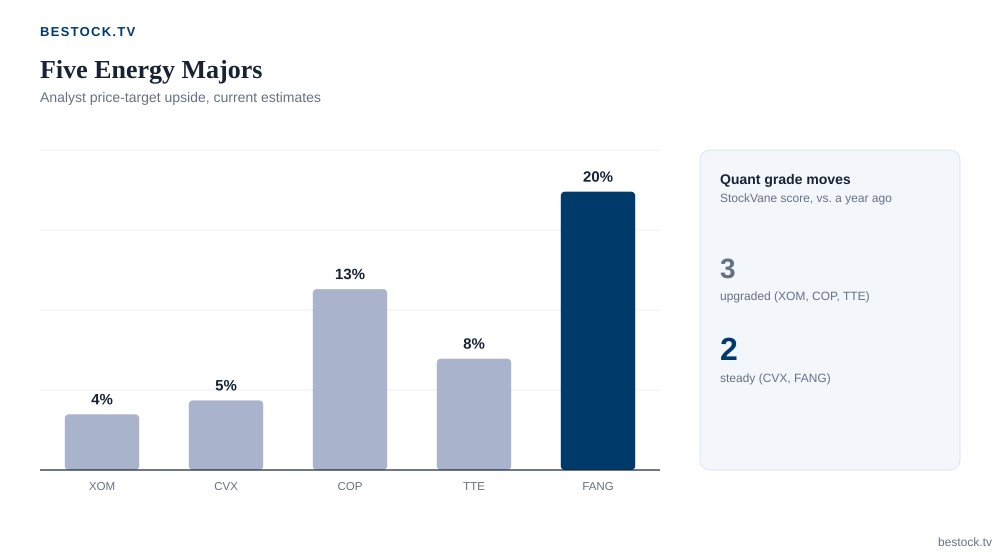
Exxon and Diamondback carry the biggest gaps between trailing and forward multiples, for opposite reasons: Exxon because a real project has not started yet, Diamondback because the trailing number itself looks off. Chevron and ConocoPhillips look the most internally consistent, one because its catalyst already happened, the other because the market has not caught up to what analysts already see.
TotalEnergies sits apart from the other four. Its trailing multiple, its forward multiple and its dividend yield all point the same direction: this is an income holding that is not asking much of the next few quarters. That is a different kind of position than the other four represent. I would not size it the same way in a portfolio built for growth from this sector. A reader chasing the growth case here is really choosing between Exxon’s Guyana bet and Diamondback’s earnings recovery. Those two names carry most of the group’s uncertainty and most of its potential reward.
The Uaru startup is the number to watch
If Uaru reaches first oil in the fourth quarter as ExxonMobil has said and Guyana’s national output pushes past a million barrels a day, Exxon’s premium has a real floor under it. I would treat the re-rating as earned rather than borrowed. If the startup slips into 2027 instead, that premium loses its main support. A stock trading near double its own five-year multiple with only 4% of analyst upside left becomes hard to defend on Guyana alone.
The real risk to this whole piece is simpler: Brent settling back into the $65 to $75 range it spent most of 2024 and 2025 in and staying there through next year. If that happens, every multiple here looks expensive regardless of whose assets are best. The case for owning any one of these five over the others would matter less than the case for owning none of them at current prices. I do not think that is the base case with the Middle East still unsettled, but it is the one I would watch for.
Analysis and opinion only, not investment advice. Figures come from each company’s second-quarter 2026 results, cross-checked against SEC filings on EDGAR and the EIA’s oil market outlook; valuation multiples and analyst targets are approximate and were checked on September 23, 2026.