
Seeking Alpha Premium Discount 2026: Save $30 + Free Trial
Seeking Alpha Premium lists at $299 a year. Search for it today and the number that actually shows up is $269, the standard first-year discount, paired with a 7-day free trial before your card is charged at all. That $30 gap looks small next to what changes once you’re inside: a rating system built to read a 10-Q faster than most people can open one.
Here is the plain version. Premium earns its price for an investor who screens a wide list of names every month, and it earns nothing for someone who already knows the five stocks they intend to hold.
Most comparison pages frame the decision around the discount alone, as if $30 were the whole story. It isn’t. The bigger question is whether the Quant Rating layer changes what a systematic screener actually does with an afternoon, and whether the pricier tiers buy anything beyond that.
Where the $269 actually goes
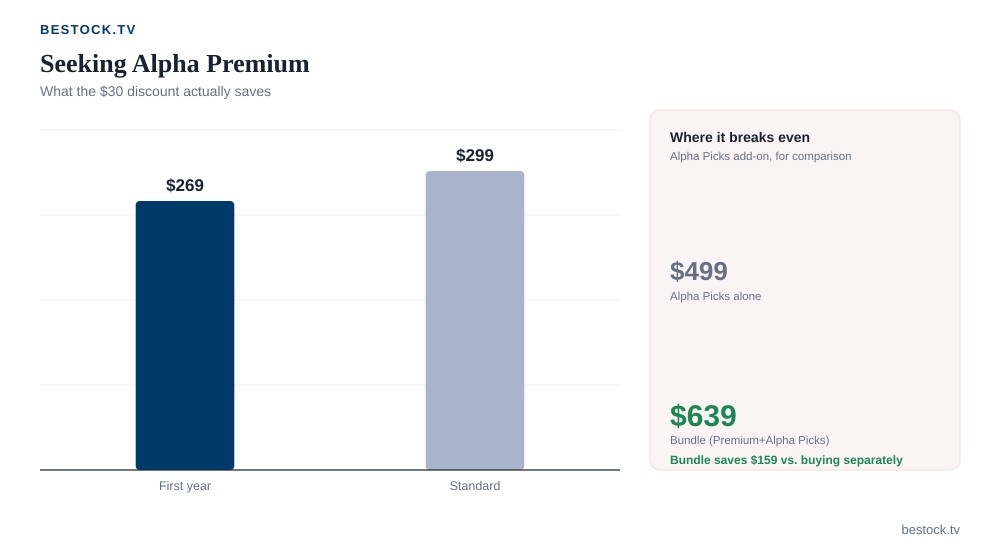
The base number is $299 a year for Premium, discounted to $269 in the first year through the standard offer, with a 7-day trial attached so the charge doesn’t land until the week is over. That’s a flat rate regardless of portfolio size, which matters against the alternative structure Seeking Alpha also sells: Alpha Picks, a $499-a-year tier that delivers two curated stock recommendations a month built on the same quant methodology, without opening the full research toolkit that Premium unlocks.
Buy both together and the bundle runs $639 for the first year, a $159 saving against paying for each tier separately. I laid out what a full platform review covers elsewhere on this site, and the pricing math holds up the same way here: the bundle beats buying Premium alone once you actually use the Alpha Picks half of it, and it’s a bad deal if those monthly picks sit unread.
What the Quant Score changes about screening
Quant Ratings pull from five factor groups, valuation, growth, profitability, momentum, and analyst revisions, then compress them into a single Strong Buy to Strong Sell call that updates as the underlying data moves. I’ve written separately about how that scoring interacts with an actual portfolio, so I won’t retread the mechanics here.
What the score changes in practice is speed, not certainty. A factor model updates the moment new revenue-revision data lands, ahead of a sell-side desk finishing a manual estimate revision, so a screener built around it tends to surface momentum shifts earlier than a name-by-name read of every filing would. It is a filter, not a verdict. A stock can carry a Strong Buy grade and still be wrong about the one variable that actually decides the business.
Pair that screening layer with a charting setup and you’ve covered both ends of the process: what to look at, and when to act on it. The indicator stack I actually use sits on the technical side of that split.
I treat the Quant grade as a first pass. Nothing more, nothing less.
The Pro tier most people don’t need
Above Premium sits Pro, priced at $2,400 a year, aimed at fund managers and institutional-adjacent users who need the Pro Quant Portfolio tool and dedicated support. That’s eight times the Premium rate for a feature set built around managing other people’s capital, not a personal watchlist.
Unless you’re running client money or a personal book large enough that the marginal research edge justifies paying for it outright, Pro is overkill. The honest test is simple: if you can’t name one thing Pro would let you do that Premium doesn’t, you don’t need it.
The renewal date that sneaks up
Every tier here is annual and auto-renews at the full list price once the first-year discount lapses. The $269 rate is a one-year entry price, not a standing rate, and the card gets charged $299 on renewal unless you cancel or catch it first.
Set a calendar reminder two weeks out. Decide fresh each year whether the subscription still earns its keep, rather than letting the renewal happen by default.
Premium, Alpha Picks, the bundle and Pro compared
| Tier | Price | What it adds |
|---|---|---|
| Premium | $269 first year, $299 after (7-day trial) | Full research tools, Quant Ratings, stock screeners |
| Alpha Picks | $499 a year | Two curated stock picks monthly, no full toolkit |
| Bundle (Premium + Alpha Picks) | $639 first year, a $159 saving | Both of the above together |
| Pro | $2,400 a year | Pro Quant Portfolio tool, VIP support, institutional focus |
One thing I can’t verify from the pricing page alone: whether the $269 first-year rate still applies to someone who already ran a free trial on a previous account. The terms don’t spell that out, so treat it as a question for support before assuming the discount stacks twice.
The case against subscribing at all is just as concrete. If you already pay for a full sell-side data terminal through your broker, or you trade a short, fixed list of names you know cold, Premium’s screening layer duplicates work you weren’t doing in the first place, and $269 buys you nothing you’d use.
The number worth watching is your own login count, not the sticker price. Fewer than two visits in the month before renewal, cancel before the card gets hit at $299. Weekly use, and a Quant grade that has changed your mind about a position at least once this year, and the subscription has already paid for itself.
Who actually breaks even at $269
Run the math on a single decision. If Premium’s Quant grade or one of its screeners steers you away from a single bad position, or into one good one, the $269 first-year cost is trivial against a portfolio of any real size. A 2% mistake avoided on a $15,000 position is worth more than five years of subscriptions. That is the case the marketing makes, and it is not wrong on its own terms. The problem is that it is also the case every research tool makes, and most subscribers cannot point to the specific decision that justified the charge.
The honest way to test it is to keep score for one quarter. Note every time the Quant grade or a screener result changes what you actually do, not just what you read. If that list has entries by the third month, the $269 earned its keep. If the list is empty and the only thing you can point to is that the site was interesting to browse, you paid for entertainment priced as research, which is a fine trade if you know that going in and a bad one if you do not.
Where it sits against the free alternative
Most of what Premium screens for is visible for free if you are willing to pull the filings yourself: revenue trends, margin direction, analyst revisions are all in a 10-Q or a data aggregator that costs nothing. What you are actually paying for is the compression, one grade instead of an afternoon of spreadsheet work, and the speed of an automated update instead of doing that work manually every time a stock moves. For someone tracking fewer than ten names, the free route is not much slower. For someone screening two hundred names a month, doing that by hand is not realistic, and the subscription is closer to a time purchase than a research purchase.
That framing also explains why the same tool works for one investor and not the next. A retiree checking on eight core holdings once a month is paying for convenience they do not need. Someone actively rotating a fifty-stock watchlist is paying for hours they would otherwise have to spend themselves, and at $269 a year, those hours are cheap if you actually use them.
The trial week is the real decision point
Seven days is not enough time to judge a research tool against a live portfolio, but it is enough time to answer one narrower question: does the interface fit how you actually work. Some people open a dozen tabs and cross-reference; others want one number and a reason. If the layout fights you in week one, it will keep fighting you in month eleven, discount or not. Use the trial to check that specific fit rather than trying to extract a full investment thesis from seven days of data, because a week is too short a window to prove or disprove whether a Quant grade is worth following.
Cancel before the trial ends if the fit is wrong, because the alternative is paying $269 to find out slowly what a careful first week would have told you for free. The risk with any subscription like this is the same one every recurring charge carries: it survives on inertia once the free week passes, whether or not you are still using it.
That inertia is the actual business model behind a $30 first-year discount. A company does not need every subscriber to use the product; it needs enough subscribers to forget to cancel before the higher rate takes over. None of that makes Premium a bad product. It just means the decision that matters is not the one you make in week one, when the trial is free and the discount is fresh. It is the one you make eleven months later, half-distracted, when the renewal charge has already gone through and canceling means asking for a refund instead of simply declining to pay.
Analysis and opinion only, not investment advice. Pricing figures come from Seeking Alpha’s subscription comparison page and its premium pricing update notice, checked on September 23, 2026.