
Apple (AAPL): Margin Growth and Buybacks Beat Unit Sales
Apple fell -7.4% the trading day after its last earnings report, more than double the stock’s own average post-earnings move of 2.9%, even though quarterly revenue rose 16% to $109.4 billion. That gap between the number and the reaction is most of what this post is about, and iPhone units don’t explain it.
I’ve read enough of these reports to know a beat can still get sold, usually on guidance or margin worry rather than the headline print. This one had both, though the margin story is the one nobody kept talking about once the sell-off started. I covered the mechanics of that particular drop in an earlier post; here I want to look past the one-day reaction at what’s actually compounding underneath it.
Here’s the sentence I’d put in front of anyone deciding whether to chase Apple at these levels: profit grew at roughly three times the pace of revenue last fiscal year, and that margin trend, stacked on a shrinking share count, is what should decide whether the stock’s premium multiple is earned. The unit totals that lead every headline are not the number to build a thesis on.
Profit outran sales by a wide margin
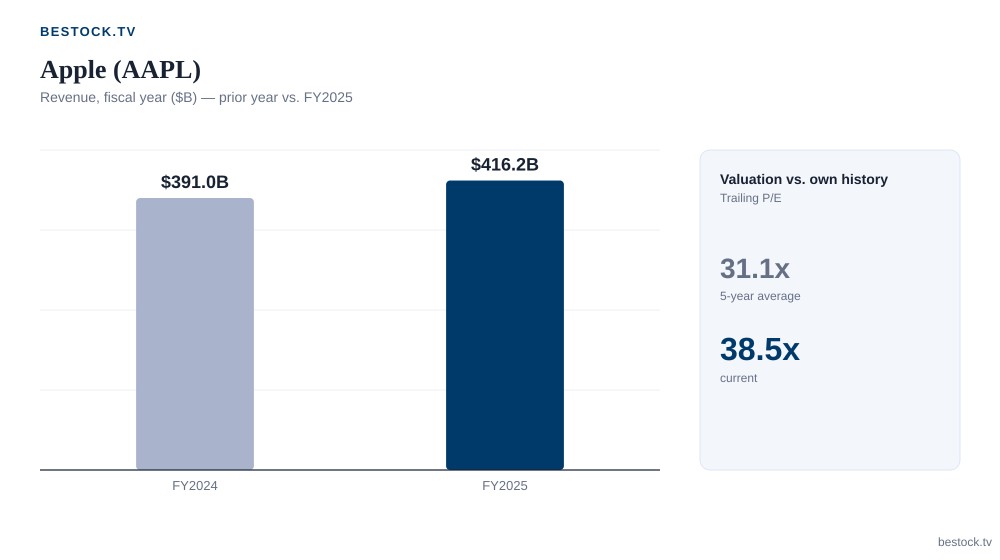
In fiscal 2025, Apple’s revenue rose to $416.2 billion from $391.0 billion the year before, a 6% gain. Net income rose to $112.0 billion from $93.7 billion, up almost 20%. Operating income was $133.1 billion, a 32% operating margin, and gross margin ticked up to 46.9% from 46.2%.
Revenue has moved from $394.3 billion in fiscal 2022 to $383.3 billion in 2023, a dip, then $391.0 billion in 2024 and $416.2 billion last year. That’s four fiscal years to add a low double-digit billions of revenue net, a rounding error next to the size of the company, and it’s exactly why profit growing three times faster than that top line is the more interesting number.
Three-quarters of a point of gross margin sounds small. Multiplied across $416.2 billion of sales, it’s nearly $2.9 billion of incremental gross profit.
None of that shows up in an iPhone unit count. It shows up one line at a time in the income statement, which is where I’d rather look first.
Why a 16% quarter still sold off
The quarter itself wasn’t the problem on paper. Revenue of $109.4 billion was up 16% year over year, though down -2% sequentially from the March quarter, an ordinary seasonal pattern for Apple that the market punished anyway. Multiply that June quarter by four and you get an annualized run rate of $437.7 billion, comfortably above the $416.2 billion Apple actually booked for all of fiscal 2025. That’s the case for patience in one number: the business, annualized, is already bigger than what showed up in the last full year.
Wall Street’s average target sits at $348, about 3% above the $336.13 the stock trades at as I write this, based on 25 analysts, 60% of whom rate it a buy. That’s not a high-conviction call. It’s closer to a shrug, a target that assumes the growth path holds and not much more. Apple’s own quant score has actually moved in the other direction lately, up to a B from a C, but a score improving after a stock has already re-rated tells you less than one improving before it does.
Apple’s market capitalization is $4,905.5 billion, still the largest figure attached to any public company, which means every percentage point of stock movement here is worth more in dollar terms than it is almost anywhere else in the market. A drop of -7.4% off a base that size erased more market value in a single session than most companies are worth outright, and that scale is part of why the reaction got so much coverage relative to the actual news.
The spread between Wall Street’s targets
The distance between the highest and lowest targets is unusually wide for a company this large: $400 at the top, good for 19% upside from here, against $245 at the bottom, a -27% cut. Twenty-five analysts covering the most-owned stock in the market don’t often disagree by that much on the reported numbers; they’re disagreeing about which growth rate to extrapolate from them. Short interest, meanwhile, is just 1.0% of the float, so almost nobody is betting against this stock in size. The argument here is about degree, not direction.
What buybacks add to the earnings math
Apple’s dividend yield is 0.31% on a trailing $1.05 a share. That number alone tells you the company isn’t trying to be an income stock; the other lever, the one that actually moves per-share results over time, is the buyback. Apple has shrunk its share count every year for more than a decade, and that’s arithmetic, not forecasting: when share count falls faster than net income grows, earnings per share grows faster than the business underneath it, dollar for dollar of profit.
Forward EPS of $9.30 against a trailing $8.72 implies about 7% growth for the coming year, only a point ahead of the 6% revenue growth built into the same forecast. That tells me the buyback effect right now is real but modest, not the multi-year compounding story it’s been at other points in Apple’s history, and I’d want to see that gap widen before I called buybacks the main event again rather than a supporting one.
There’s a meaningful difference between a buyback funded out of free cash flow and one funded by adding debt, and it matters for how durable the program is if growth ever stalls for a year or two. I don’t have a clean read on that split from the figures in front of me, so I’d treat the buyback as a background tailwind worth checking each year rather than one to assume on faith indefinitely.
A multiple that already prices the good version
At 38.5 times trailing earnings, Apple trades well above its own five-year average of 31.1 times, and the forward multiple of 36.1 times isn’t much of a discount to that. On sales it’s richer still: 10.5 times revenue against a five-year average of 7.8 times, a gap that’s hard to square with 6% revenue growth in the denominator. The live numbers are on Apple’s valuation page, since multiples move by the day.
Price-to-book, by contrast, is almost unchanged: 45.6 times now versus a five-year average of 45.5 times. That’s the one multiple that hasn’t re-rated, which I read as the earnings and sales multiples moving on profitability expectations rather than on the market suddenly valuing the underlying assets differently.
Net margin of 27% sits under an operating margin of 32%, a gap that’s mostly taxes and non-operating items rather than anything unusual in the business. The level itself is the notable part: few companies this size keep roughly a quarter of every sales dollar as profit, and that base rate is what the market is paying more than 38.5 times for, not the growth rate on top of it.
Compare that with two names I’ve covered recently. Microsoft, priced for very little room to disappoint, trades at 27.5 times earnings on faster growth than Apple’s. Alphabet, at the other end, trades at 17.5 times earnings, less than half Apple’s multiple. Either the market is wrong about one of these three, or it’s paying Apple a premium for consistency and capital return that a trailing P/E doesn’t fully capture by itself. Some of that margin story also depends on chip supply, which is really a story about the foundry doing the fabricating; I’ve written separately about how much pricing power sits with the company that makes almost every advanced chip on the planet, and Apple’s margin assumptions lean on that relationship staying favorable.
| Metric | Apple now | Context |
|---|---|---|
| P/E (TTM) | 38.5 | 5-yr avg 31.1 |
| P/E (forward) | 36.1 | implies 7% EPS growth |
| P/S (TTM) | 10.5 | 5-yr avg 7.8 |
| Gross margin (FY2025) | 46.9% | prior year 46.2% |
| Net income (FY2025) | $112.0 billion | prior year $93.7 billion |
| Revenue (FY2025) | $416.2 billion | prior year $391.0 billion, +6% |
| Analyst target (avg) | $348 | 3% above current price |
| Dividend yield | 0.31% | trailing $1.05/share |
Numbers like these are why I keep coming back to the margin line instead of the unit count when I size up this stock. The units make the headline. The margin decides the multiple.
The case against paying full price
What I can’t resolve from these figures alone is how much of the margin gain is mix, meaning a shift toward higher-margin products and services in the sales blend, versus straightforward pricing power. Apple’s headline numbers don’t split that out for me, so I’m reading the trend here, not its exact composition, and I’d hold that view loosely rather than as settled fact.
The clearest risk to this view is straightforward: if gross margin gives back the ground it just gained before revenue growth reaccelerates, the multiple has no margin story left to lean on, only a growth story that’s already cooling. That combination, margin down and growth down together, is the one that would make me rethink holding at this price rather than adding to it.
If Apple’s next two quarters of revenue growth instead come in at or above the 16% just reported, without gross margin giving back that ground, the argument that this multiple is too rich gets a lot harder to make, and I’d take that as a sign I had the balance backward. Revenue reacceleration paired with margin held is the one combination that beats this thesis outright.
The number I’m watching now is the same one that mattered this quarter: gross margin. If it holds near 46.9% through the next two reports while growth cools toward the high single digits, the earnings-per-share engine that buybacks built keeps running quietly in the background. If margin slips first, the multiple has a lot further to fall than the revenue line does.
Analysis and opinion only, not investment advice. Figures come from Apple’s filings on SEC EDGAR and its investor site; valuation multiples are approximate and were checked on 2026-09-18.