
Fidelity Review: What the Full-Service Broker Still Does Best
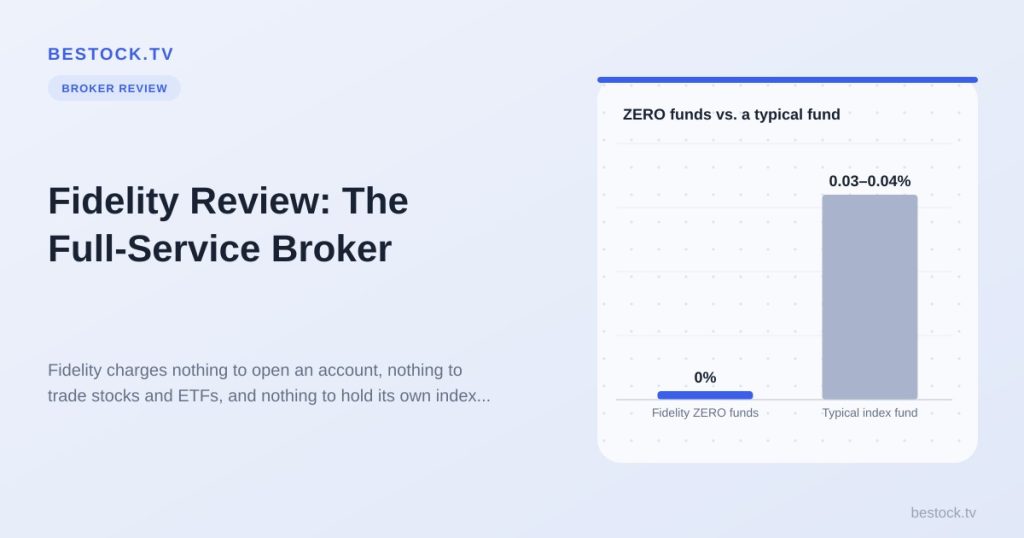
Open a Fidelity brokerage account this week and the cost of getting started is zero. No minimum deposit, no fee to buy a stock or an ETF, and no fee to hold the index funds the company built specifically to charge nothing at all. That is not a limited-time offer sitting on a landing page. It is the account structure Fidelity has run for years, and it is the reason the broker keeps showing up on my desk even when the app itself looks like it was designed for a different decade.
I opened an account, pulled the current fee schedule straight from Fidelity’s own site, and checked the fund lineup fund by fund rather than trusting a marketing page. Here is what actually held up.
My take: Fidelity’s real pitch isn’t speed or a slick interface. It’s that one account can carry almost everything a long-term investor needs — a taxable brokerage, an IRA, a health savings account, a place for cash to sit between decisions — without charging for most of it. The tradeoff shows up the moment you want to trade options actively or touch crypto, where app-first brokers built a decade later simply feel faster and more focused on that one job.
What Fidelity actually charges
Online trades in US stocks and ETFs carry a $0 commission, according to Fidelity’s own pricing page, which also lists options trades at $0 commission plus a $0.65 per-contract fee. There is no minimum deposit to open the account itself. None of that is unusual anymore among the large brokers, but it is worth confirming directly rather than assuming, because per-contract options pricing is exactly the kind of number that drifts a few cents every year or two without much announcement.
| Trade type | Cost |
|---|---|
| US stocks and ETFs, online | $0 commission |
| Options, online | $0 commission + $0.65 per contract |
| Account minimum to open | $0 |
What that table doesn’t show is margin rates, which scale with balance size the way they do at most full-service brokers, and which I’d size against your own borrowing cost elsewhere before treating margin as cheap just because the commission line reads zero. Zero-dollar stock and ETF commissions aren’t unique to Fidelity anymore; the whole industry converged on that number after 2019. What still separates the full-service brokers from the app-first ones is everything sitting underneath that headline number: account variety, fund selection, and what happens to cash that isn’t actively invested.
The ZERO funds are the actual differentiator
Fidelity’s most distinctive product isn’t a trading feature at all. It’s a small family of index funds carrying the word ZERO in their names, and the word is literal. The Fidelity ZERO Total Market Index Fund, ticker FZROX, charges a 0% expense ratio and has no minimum investment. Its companion fund, the Fidelity ZERO International Index Fund under ticker FZILX, does the same for foreign developed and emerging-market stocks. Neither fund pays Fidelity anything directly for holding it, which is a distinctly different pricing model from a typical index fund charging even a token 0.03% or 0.04%. Fidelity also runs a ZERO large-cap fund and a ZERO extended-market fund under the same no-fee structure, so an investor building a full US-plus-international portfolio out of these four funds alone pays nothing in fund expenses at all, only whatever bid-ask friction exists on the day they buy.
The catch, and there is one, is that these funds are only available inside a Fidelity account and cannot be transferred to another broker in kind. Move your money out later and you have to sell the fund first, which means realizing whatever gain or loss has built up on a specific date rather than on your own schedule. For an investor who plans to stay put for a decade, that restriction is close to irrelevant. For someone who likes to keep accounts portable, it’s a real constraint worth weighing before building a core position around a fund you can only own in one place.
Where uninvested cash actually sits
The default core position for a new Fidelity brokerage account is SPAXX, the Fidelity Government Money Market Fund, which invests in short-term US government debt and repurchase agreements rather than sitting as plain uninvested cash. That structure means idle money between trades earns a floating yield instead of nothing, which has been a real edge over brokers whose default sweep account pays close to zero.
I’ll flag the one number I couldn’t pin down with confidence: the current 7-day yield on SPAXX moves with short-term interest rates and I don’t have a source I’d stand behind for today’s exact figure, so I’m not printing one here. Check it directly on Fidelity’s site before you compare it against a competing broker’s sweep rate, because the gap between them is precisely the kind of detail that changes the calculation month to month.
Account types cover more ground than an app-first broker
This is where the “one account for almost everything” pitch earns its keep. Fidelity’s own account overview lists individual and joint brokerage accounts, Traditional, Roth, Rollover and SEP IRAs, a health savings account, 529 college savings plans, and custodial accounts for a minor. The HSA specifically carries zero account fees and zero account minimums, which matters because HSAs at some other providers still charge a small monthly fee below a balance threshold.
| Account type | Minimum / fee |
|---|---|
| Individual or joint brokerage | No minimum, no account fee |
| Traditional, Roth, Rollover, SEP IRA | No minimum, no account fee |
| Health savings account | Zero account fees, zero minimum |
| 529 college savings | State plan rules apply |
A reader comparing this against something like Moomoo Canada’s account setup will notice the difference immediately. I tested Moomoo’s fees and account types directly, and it covers a narrower registered-account lineup by design, because it’s built as a trading app first and a retirement-planning tool a distant second. Fidelity is built the other way around.
Research most brokers charge extra for
Fidelity bundles in research that some competitors either paywall or simply don’t offer: stock, ETF and crypto screeners, professional third-party research reports, a dedicated mutual fund screener, and options research tools, all included with a standard account according to Fidelity’s own trading-tools page. The more active platform, Fidelity Trader+, adds advanced charting and custom layouts across both web and mobile. Weekly webinars and daily market briefings round it out.
None of this is flashy. It’s also not nothing, and I’d rather have a research report I can actually read before placing a trade than a slicker order ticket with no analysis behind it.
Where Fidelity is actually behind
Crypto access is thin compared with an app built around it, and the options-trading experience, while functional, doesn’t move as fast as the chain-and-chart layouts on newer platforms designed around high-frequency options trading. I’ve spent time in Moomoo’s charting tools directly, and against Interactive Brokers on the same measure, and that comparison is a useful reference point for what an app built for active trading looks like when it’s optimized for exactly that one job. Fidelity’s mobile app handles the basics fine but doesn’t compete on that specific ground, and it isn’t trying to.
An investor who wants gamified, tap-to-buy simplicity above everything else, or who trades options several times a day and wants the fastest possible chain view, will find Fidelity slower to use for that narrow purpose. That’s a real cost. It’s just not the cost most long-term investors are actually paying for.
Here’s the condition that would actually break my argument: if you’re funding an account with a small amount, trading options weekly, and never touching the retirement or cash-management side of things at all, then none of the account-variety advantage applies to you, and you’re paying for infrastructure you won’t use. In that specific case, an app-first broker built around fast options execution is the better fit, full stop.
Who this account actually fits
Pick Fidelity if you want one login that holds a brokerage account, a Roth IRA, an HSA and a cash position that earns something, and you’re not trying to day-trade options for a living. Pick an app-first broker instead if speed and interface are the actual point of your account, not a side benefit.
The number I’d check before funding anything here is the live 7-day yield on SPAXX against whatever your current broker pays on idle cash. If that gap is under half a percentage point, the cash-management edge stops mattering and the decision comes down to which account you’d actually open every morning.
Analysis and opinion only, not investment advice. Fee, fund and account-minimum figures come from Fidelity’s own commissions, fund-research and account-overview pages, checked directly on September 26, 2026; the comparisons to other brokers are my own judgment.