
Robinhood Review: Fees, Options, Crypto and the Real Catch
Robinhood will add three cents on every dollar you put into an IRA this year, a 3% match, as long as you pay five dollars a month for Robinhood Gold and leave the matched money in the account for five years. Miss either condition and part of that match gets clawed back. That single mechanic tells you more about how this brokerage actually earns money in 2026 than the zero-commission banner on its homepage does, because free stock trades stopped being rare around 2020, once every serious competitor matched the price.
The corporate structure underneath the app is more layered than most users ever check. Stocks and options sit with Robinhood Financial LLC, cleared through Robinhood Securities LLC, both members of the Securities Investor Protection Corporation. SIPC coverage caps out at $500,000 per customer, with a $250,000 sub-limit for cash, a ceiling every U.S. broker operates under and not something Robinhood set itself. Crypto is a separate animal. It runs through Robinhood Crypto, isn’t a security, and carries no SIPC protection at all, a distinction the app’s single unified balance screen does its best to blur.
My read on Robinhood heading into the last quarter of 2026: the part of this product actually worth choosing is the IRA match bundled into Gold and the fact that equities, options and crypto share one login, not commission-free trading, which every serious broker now offers for free. Where it still falls short is everything a full-service shop treats as baseline — mutual funds, bonds you can actually browse and buy, research written by an analyst rather than surfaced by an algorithm.
That gap is not a dealbreaker for the account this platform is actually built for. It is a dealbreaker if you are trying to make Robinhood your only brokerage account.
The fee sheet nobody reads
Commissions on U.S.-listed stocks, ETFs and their options are $0 through the app, and that part of the marketing holds up. What isn’t free are the regulatory pass-throughs every U.S. broker has to collect, and Robinhood’s own posted fee schedule breaks them out in more detail than most competitors bother to publish. Sell a stock and a Trading Activity Fee of $0.000195 per share rides along, capped at $9.79 a trade; sell an option and the same fee applies at $0.00329 per contract instead. Sell anything and a sliver of the SEC’s own transaction fee comes with it, currently $20.60 per $1,000,000 of principal, a rate the SEC resets each year, not Robinhood.
Options carry an actual per-contract charge on top of those regulatory fees, and this is the one place Gold subscribers get a break that is scheduled to disappear. Non-Gold accounts pay $0.50 per contract on top of a $0.04 Options Regulatory and OCC Clearing Fee. Gold accounts currently pay $0.35 per contract instead, but Robinhood’s own schedule shows that discount ending October 15, 2026, when the rate moves to the same $0.50 everyone else pays. An options trader picking Gold partly for that fifteen-cent difference should know the math changes in a few weeks, not build a plan around it.
| Fee | Amount |
|---|---|
| Options contract fee, non-Gold | $0.50 per contract |
| Options contract fee, Gold (until Oct 15, 2026) | $0.35 per contract |
| Options Regulatory & OCC Clearing Fee | $0.04 per contract |
| Trading Activity Fee, equity sells | $0.000195 per share, capped at $9.79 |
| SEC regulatory fee (sells) | $20.60 per $1,000,000 of principal |
Crypto pricing hides in the spread
Crypto trading through Robinhood’s default order routing carries no line-item commission, and that is exactly the problem with judging it by the fee schedule alone. Default routing sends orders to market makers, and Robinhood is compensated by those market makers rather than by a fee charged to you directly, so the cost shows up as a wider effective spread rather than a number on a receipt. Robinhood does publish an alternative: switch to Exchange Routing in the Robinhood Crypto fee schedule and you see actual maker and taker rates, tiered by trailing 30-day volume, starting at 0.95% taker and 0.50% maker under $10,000 and stepping down to 0.03% and 0.00% above $25 million.
Almost nobody trading a few hundred dollars a month bothers switching routing modes. That’s the point. The spread most retail crypto traders actually pay is invisible by design, not hidden by omission, and it’s a five-minute read to see the tiers you aren’t using.
Robinhood also takes a cut of crypto staking rewards, 25% of whatever the network pays out, a steeper commission than several dedicated staking services charge and one that rarely gets mentioned next to the free-trading pitch.
What five dollars a month buys
Robinhood Gold costs $5 a month, and the IRA match is the single biggest reason to consider it. Contribute to a Robinhood IRA without Gold and the match is 1%. Subscribe to Gold and it rises to 3%, but Robinhood attaches real conditions, detailed in its own IRA match disclosures: the matched dollars have to stay in the account for five years, and you have to keep paying for Gold for at least a year after your first match or the extra 2 percentage points get removed retroactively. Read that as a multi-year commitment dressed up as a signup bonus, not a one-time credit.
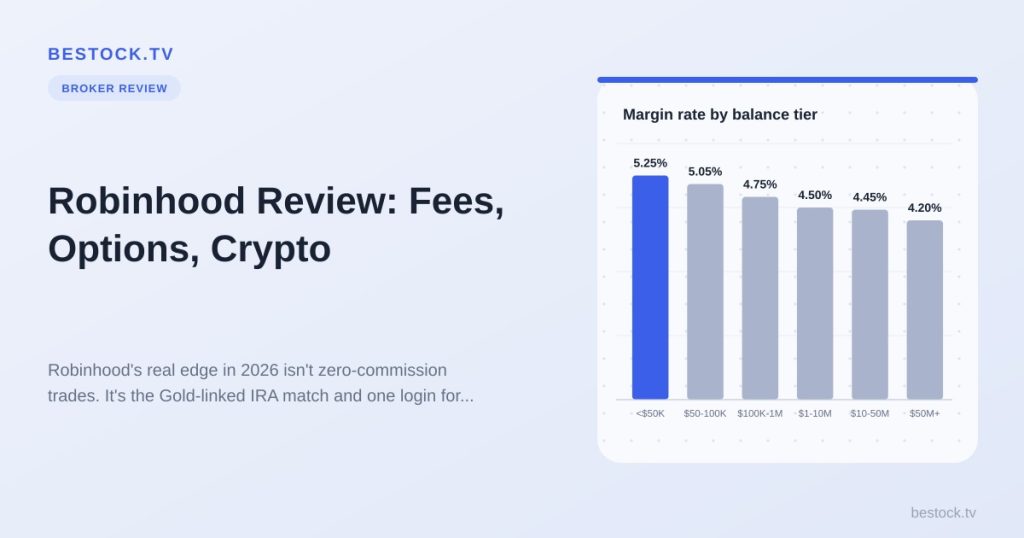
Gold also unlocks margin investing, deeper Level II market data, and bigger instant deposit limits, none of which matter to an account that never borrows or trades pre-market. Margin rates scale down as the borrowed balance grows, and Robinhood’s current schedule runs like this.
| Settled margin balance | Margin interest rate |
|---|---|
| Up to $50,000 | 5.25% |
| $50,000 to $100,000 | 5.05% |
| $100,000 to $1 million | 4.75% |
| $1 million to $10 million | 4.50% |
| $10 million to $50 million | 4.45% |
| $50 million or more | 4.20% |
A trader carrying a small margin balance sits near the top of that table, not at the average rate a promotional email tends to quote.
Opening the account, in practice
Account opening is standard for a modern app-first broker and doesn’t take long: name, Social Security number, employment and income details, a short suitability questionnaire, then linking a bank account to fund it. Robinhood supports individual taxable accounts, joint accounts, and both traditional and Roth IRAs, and fractional shares are available on most listed stocks, which matters more than it sounds for anyone funding an account with a few hundred dollars rather than a few thousand. What it doesn’t support is the account menu a full-service brokerage offers: no trust accounts, no custodial accounts, no advisor to call when a rollover gets complicated.
None of that is a hidden flaw. It’s the tradeoff for a lean, mobile-first account structure.
Where the app runs out of road
The clearest gap shows up the moment you try to move money in from somewhere else. Robinhood doesn’t support mutual funds or bonds you can browse and buy directly, so an IRA rollover carrying either has to be liquidated at the old broker before the cash lands, which can force you out of a fund you wanted to keep or complicate a transfer you expected to be simple. Research inside the app is thin next to a full-service shop too: basic fundamentals and analyst ratings, not the sector reports or fixed-income desk research a full-service broker bundles into an advisory relationship. I found the same kind of tooling gap comparing Moomoo’s charting against Interactive Brokers’ deeper research stack: the cheaper, app-first broker wins on cost and speed, and loses on depth, and that pattern holds here too.
So who is this actually for
The account this platform is built for is small to mid-sized, wants stocks, options and crypto under one login, and is contributing to an IRA it plans to leave alone for years rather than actively managing bond ladders or mutual fund positions inside it. For that account, the Gold subscription earns back its own $60 annual cost once the extra 2 percentage points of match — by my own math, not a figure Robinhood publishes — apply to about $3,000 of yearly IRA contributions, comfortably inside typical annual limits, and the unified app experience is a real convenience rather than a marketing line.
I’ll admit the fee side has more moving parts than I expected before I read the actual schedule, and Robinhood revises specific numbers on its own posted timeline more often than most reviews catch, including the options fee change landing this October. The concrete case where this account works against you: someone consolidating a six-figure rollover that includes mutual funds and individual bonds, expecting a clean transfer, only to find those positions have to be sold first and the proceeds arrive as cash, on Robinhood’s timeline, not theirs.
Sign-up promotions on brokerage accounts deserve the same skepticism no matter which platform is running them. I made this point writing about Moomoo Canada’s deposit-tiered bonus and its holding-period fine print, and it applies here too: whatever new-account offer Robinhood happens to be running when you read this is worth checking directly on its own site before you fund anything, since terms like these get revised more often than reviews of them do. The account structure and the fee schedule are the parts that don’t change every quarter, and those are what I’d actually weigh a decision on.
My verdict: open it for the IRA match and the convenience of one account across stocks, options and crypto, not because the trades are free. Everyone charges nothing for that part now.
Analysis and opinion only, not investment advice. Fee figures, margin rates and IRA match terms come directly from Robinhood Financial’s and Robinhood Crypto’s own posted fee schedules and Robinhood’s IRA match disclosures, checked September 26, 2026; SIPC coverage figures come from SIPC’s own published limits. The break-even contribution figure above is my own calculation, not a number Robinhood publishes; confirm current fees and terms directly on Robinhood’s site before acting, since brokers revise pricing without much notice.