
Cloudflare (NET): Growth Keeps Accelerating, Margin Keeps Sliding
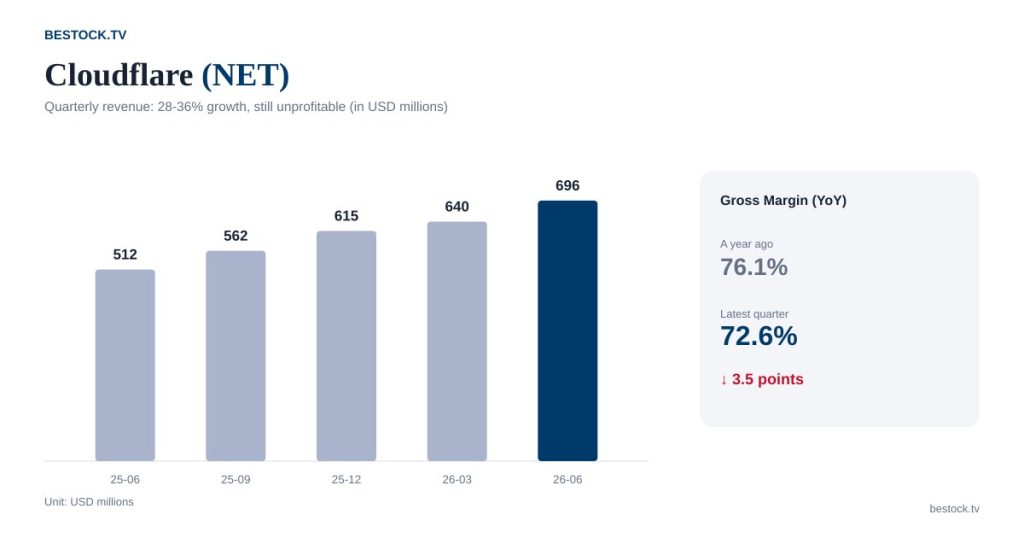
Cloudflare has grown revenue at 28% to 36% a year for five straight quarters and still hasn’t posted a quarterly GAAP profit in that stretch. I’m not writing this to pile on a company that’s actually executing well on growth. I’m writing it because the gap between “growing fast” and “making money” at Cloudflare is wide enough that I think it deserves more scrutiny than it usually gets in the headlines.
The Growth Rate Hasn’t Slipped
Revenue: $512 million, $562 million, $615 million, $640 million, $696 million, with year-over-year growth of 27.8%, 30.7%, 33.6%, 33.5%, and 35.9% across those five quarters, actually accelerating into the most recent print. Cloudflare’s network-as-a-platform pitch, security, performance, and compute all running on the same edge infrastructure, keeps landing with enterprise customers who are consolidating vendors rather than adding more point solutions. That part of the story holds up.
Gross Margin Is Sliding While Growth Climbs
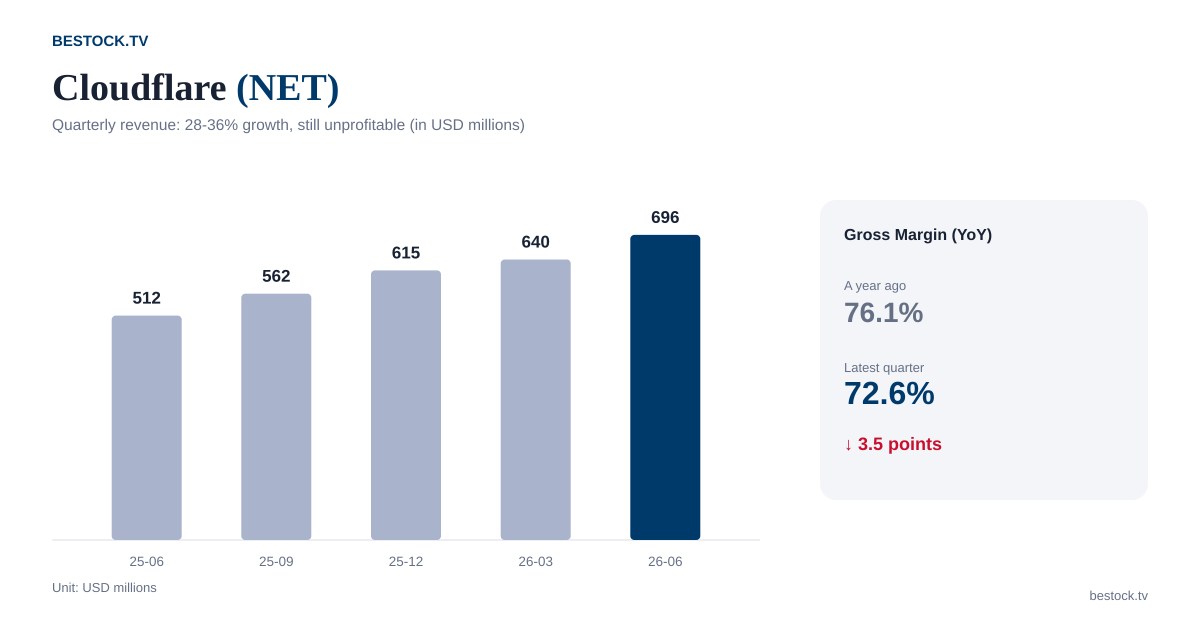
Gross margin has dropped from 76.1% a year ago to 72.6% now, a decline of 3.5 points, and it’s been falling every single quarter in this five-quarter stretch, not just in the latest one. That’s the detail that actually worries me more than the growth rate reassures me. A newer product mix with heavier compute and AI-inference workloads typically carries lower margins than Cloudflare’s traditional CDN and security business, so this decline likely reflects where the growth is coming from rather than pricing pressure on the legacy business. I haven’t confirmed that segment mix directly from the filing, so I’m presenting it as the most plausible explanation rather than a confirmed one.
Net Losses Haven’t Narrowed on Any Clear Trend
Net losses across these same five quarters ran roughly $50 million, $1 million, $12 million, $23 million, and $170 million, with that last number representing a sharp year-over-year widening of the loss rather than the gradual path to breakeven that bulls on this stock have been expecting for years now. Stock-based compensation is a large piece of why GAAP losses look worse than the cash-flow story Cloudflare likes to emphasize on its earnings calls, and I’d want to see the actual cash flow statement before treating this quarter’s wider loss as a genuine deterioration rather than a one-time item. I don’t have that breakdown confirmed here, so I’m flagging the number rather than explaining it away.
Table: The Numbers Side by Side
| Metric | Value | Context |
|---|---|---|
| Share price | $289.58 | 52-week range $158.83 to $370.35 |
| P/E (TTM) | Negative | no GAAP profit over the trailing year |
| Forward P/E | Negative | consensus still doesn’t expect near-term GAAP profit |
| Market cap | $103.1 billion | |
| Dividend yield | 0% | no dividend |
| Analyst rating | 25 analysts, 84% Buy | |
| Average price target | $365.39 | about 26% above the current price |
I’m not showing a historical P/E range here the way I usually do in this series. Cloudflare’s own trailing average multiple is negative, a mathematical artifact of years without GAAP profit, and plotting the current price against that history wouldn’t tell you anything useful. That’s a deliberate omission, not an oversight.
What Would Actually Convince Me
A single quarter of GAAP profitability wouldn’t change my view much on its own. What would is gross margin stabilizing anywhere above 73% for two consecutive quarters, which would tell me the compute and AI workload mix shift has found a floor rather than continuing to dilute the business. Until I see that, I’m treating the margin trend as the more important number than the revenue growth rate, however good that growth rate looks in isolation.
What I’m Doing, and the Number I’m Watching
I don’t own Cloudflare right now, and the margin trend is the specific reason why, not the growth rate, which I have no complaint about. The number I’m watching next quarter is gross margin, not revenue: a bounce back toward 74% would get my attention, while another decline toward 70% would confirm the mix-shift drag is getting worse, not better.
Analysis and opinion only, not investment advice. Figures come from the company’s recent filings and our market data snapshot.