Best AI Stocks to Buy Now: Six Names Beyond the Chipmakers
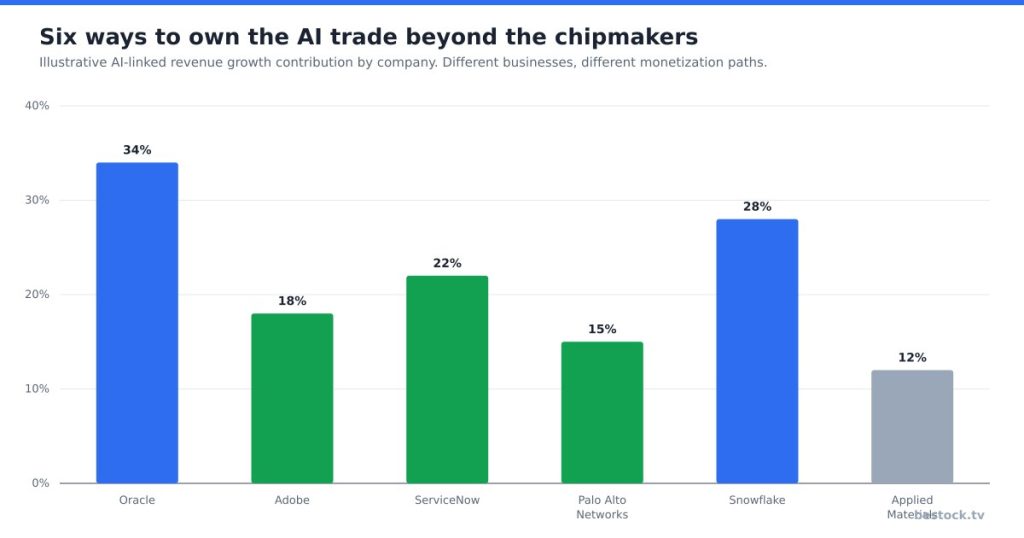
Oracle’s quarterly revenue grew 30% and the stock trades at 23.1 times earnings, roughly ten points below its own five-year average multiple of 34.7. Growth up, multiple down. That gap is the shape of every name on this list, in one direction or the other.
My thesis across all six: each company is monetizing AI directly inside a product it already sells, not bolting a chatbot onto an old pitch deck, and in most cases the market has not finished repricing that yet, though the six sit in very different places on the profitability spectrum and should not be bought as a single basket.
I ranked these by how directly AI shows up in the numbers, not alphabetically, and I will flag where I would be cautious as I go.
Oracle trades below its own five-year multiple
Oracle’s cloud infrastructure business is why a former database company is growing revenue 30% a quarter, to $19.3 billion, and 17% for the full fiscal year, to $67.4 billion. Net income for the year came to $17.1 billion, up from $12.4 billion, a jump that outran the top line. The stock trades at 23.1 times trailing earnings against a five-year average of 34.7, even after climbing off its 52-week low of $114. It is 54.7% below its 52-week high of $326, which tells you how violently sentiment has swung around this name over the past year.
The quant score I track slipped from a D to an E over that period, the model’s way of saying the recent run is outpacing the fundamentals even though the fundamentals themselves look fine. The average price target of $254 implies 72% upside from the $147.61 the stock trades at as I write this, a gap wide enough that I would treat it as a sign analyst targets have not caught up with the price collapse, not a promise the stock gets there. I have made the case that Nvidia’s moat is software, not just chips; Oracle is a different bet on the same compute buildout, selling capacity instead of the silicon itself.
Adobe’s price fell faster than its growth did
Adobe’s Firefly generative models are trained on licensed and owned content, which sidesteps the copyright exposure some rivals carry, and the company built Firefly into Photoshop and Illustrator rather than shipping it as a separate app nobody opens. Quarterly revenue grew 13% to $6.8 billion, and full-year revenue rose 11% to $23.8 billion. That is modest growth by this list’s standard.
The multiple compression is the real story. Adobe trades at 13.9 times trailing earnings against a five-year average of 36.2, one of the widest gaps on this list, and only 38% of the analysts covering it rate it a buy, the lowest conviction of the six names here. I read that as the market still deciding whether Adobe’s incumbency in creative software protects it from AI-native tools that can generate an image without touching an Adobe product at all, and that is a real uncertainty I cannot resolve from the numbers alone. At under 13.9 times earnings, Adobe does not need the growth rate a 35 P/E stock does to justify its price; it needs to not lose share, which is a lower bar.
Where ServiceNow’s optimism is already priced in
ServiceNow’s AI agents are built to complete IT workflow steps on their own, submitting a ticket, provisioning access, closing it out, rather than just answering questions about how to do it, and that shift from assistant to actor is why the company can still grow revenue 24% a quarter to $4.0 billion. Full-year revenue is up 21% to $13.3 billion.
90% of the 29 analysts covering the stock rate it a buy, the highest conviction of any name on this list, and yet the average target of $142 implies only 5% upside from the $135.47 price. When the highest buy percentage on this list produces the smallest expected gain, the optimism is mostly already in the price, not a signal there is more room to run. The stock trades at 84.7 times trailing earnings, rich in absolute terms even though that is a fraction of its own 228.1 multiple five years ago, back when the company was barely profitable and traded on growth alone.
A net loss that isn’t the whole story
Palo Alto Networks reported full-year net income of just $0.3 billion, down from $1.1 billion, even as revenue grew 24% for the year and 34% in the latest quarter, to $3.4 billion. That is the kind of number that would normally worry me on its own.
It is explained in large part by integration charges tied to the roughly $25 billion CyberArk acquisition and the Chronosphere deal, disclosed in the company’s fiscal fourth-quarter results filed on SEC EDGAR; on a non-GAAP basis, which strips those charges out, net income rose year over year. I still want two more quarters of GAAP numbers before I treat the loss as fully explained by one-time costs, because that is exactly the kind of claim that gets used to wave away real deterioration too. The stock trades near its highs regardless, only 8.8% off its 52-week high, and 87% of analysts still rate it a buy with a target of $415, 14% above the current $363.58. The market seems to be taking the non-GAAP framing at face value.
Still unprofitable, still the highest target upside
Snowflake’s net loss held at $-1.3 billion for the year, essentially unchanged from $-1.3 billion the year before, even as revenue grew 35% in the quarter and 29% for the full year, to $4.7 billion. Profitability is not the pitch here; growth durability is.
The stock jumped +16.6% on its last earnings day, one of the largest reactions on this list, and the average analyst target of $435 implies 31% upside from the $332.43 price, the widest gap of the six names. 91% of analysts rate it a buy. That is a lot of conviction attached to a company that still loses money on every dollar of revenue it books, and if growth slows before Snowflake reaches profitability, that target comes down with it.
The picks-and-shovels stock got expensive too
Applied Materials sits underneath every name on this list, selling the equipment that makes the chips those companies’ AI models run on. Quarterly revenue grew 25% to $9.1 billion, though full-year revenue growth is a slower 4%, to $28.4 billion, a gap that tells you the AI-driven acceleration is recent and not yet visible in the multi-year trend. I wrote about this same lag showing up across the supply chain in a piece on the semiconductor cycle hiding behind AI capex.
Net income was essentially flat, $7.0 billion versus $7.2 billion a year earlier, while the stock trades at 38.4 times trailing earnings against a five-year average of 23.0. That is expensive for a business growing net income near zero, and the average target of $692 implies 56% upside from today’s $444.57, the largest gap on this list in dollar terms. I would treat that target with more skepticism than the growth names above; equipment makers tend to get repriced down hard once the buildout they sell into slows, and Applied Materials’ own numbers do not yet show why this cycle avoids that pattern.
Short interest on the stock sits at 2.0% of shares outstanding, low enough that a disappointing order number would not get amplified by a short squeeze unwinding in the other direction. That is a small comfort next to a 38 multiple, not a reason to ignore it.
| Company | Price | Trailing P/E | Qtr revenue growth | Analyst upside |
|---|---|---|---|---|
| Oracle | $147.61 | 23.1 | 30% | 72% |
| Adobe | $248.92 | 13.9 | 13% | 10% |
| ServiceNow | $135.47 | 84.7 | 24% | 5% |
| Palo Alto Networks | $363.58 | 909.0 | 34% | 14% |
| Snowflake | $332.43 | -104.9 | 35% | 31% |
| Applied Materials | $444.57 | 38.4 | 25% | 56% |
Where I’d start if I only picked two
If I had to underwrite two of these six today, I would start with Oracle and Snowflake, the two names combining the fastest revenue growth with valuation gaps wide enough to survive a disappointing quarter without falling apart. Adobe is the value case, not the growth case, and needs a different kind of patience.
None of these six behave like a single sector bet, which is part of why I laid them out separately instead of averaging them into one score. Oracle and Applied Materials rise and fall with capital spending decisions made by a handful of hyperscale customers. Adobe and ServiceNow depend on enterprise software budgets that move on a slower, calmer cycle. Snowflake and Palo Alto Networks are still proving out unit economics under AI-era demand, one through losses that have not narrowed and one through an acquisition that temporarily wrecked the income statement. Owning all six is closer to owning six different theses about how AI spending flows through an economy than it is to owning one trade on artificial intelligence.
The risk across all six is the same one: AI infrastructure spending is running well ahead of demonstrated payback industry-wide, and if that capital cycle turns before these six companies’ AI products fully monetize, the cheaper multiples in this group compress further instead of catching up to their averages. That is the single risk I would want disproven before adding to any of them. How much of a portfolio any one deserves is a separate question from whether it belongs on a watchlist, and I have written separately about sizing a position when volatility runs high.
Analysis and opinion only, not investment advice. Figures come from each company’s SEC EDGAR filings, including Oracle’s and Palo Alto Networks’, along with their investor sites; valuation multiples are approximate and were checked on September 23, 2026.
Related Reading
 CVS
CVS
CVS Stock at 13.6 Times Forward Earnings: Is the Estimate Stale?
CVS Health trades at 23.4 times trailing earnings and 13.6 times forward earnings, and the raised 2026 guidanc…
 News
News
Target Stock: Traffic Is Up 3.6%, Margins Have Not Followed
Target's comparable traffic grew 3.6% last quarter and the stock has nearly doubled from its low. At 16.4 time…
 News
News
Five Footnotes I Read Before I Trust a Balance Sheet
A balance sheet shows totals; the notes show how they were built. Here are the five footnotes I open first, wh…