
DoorDash at 91 Times Earnings: What Has to Keep Going Right
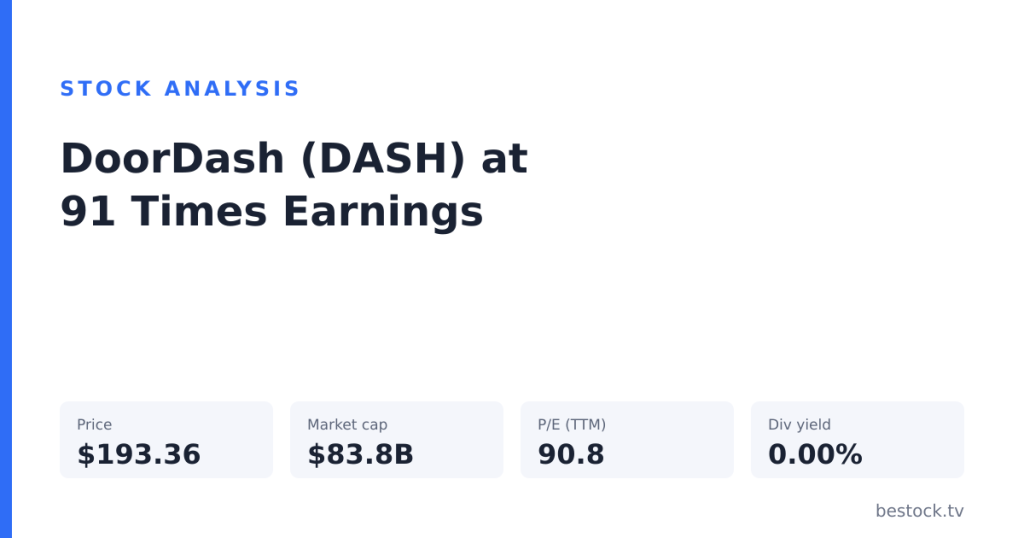
DoorDash trades at 90.78 times trailing earnings this week, and the number sitting underneath that multiple just moved in the wrong direction. GAAP net income fell 30% year over year last quarter, even as revenue grew 36%. A stock priced like a bet on years of future margin doesn’t usually keep climbing while its actual profit shrinks, and yet that’s exactly what’s happening with DASH right now.
I went into the second-quarter numbers expecting the usual story, order growth outrunning profit growth, and found something more specific than that. Adjusted EBITDA rose 40% to $914 million, well ahead of what the company had guided to, while GAAP net income attributable to shareholders landed at $200 million, down from roughly $286 million a year earlier. Both of those are real figures from the same three months. The gap between them is most of the argument for or against this stock.
Here’s the sentence I’d put in front of anyone pricing DASH at 91 times earnings: almost none of that multiple is paying for the $200 million DoorDash actually earned last quarter. It’s paying for Adjusted EBITDA margin continuing to climb for several more years, and the one line that has to keep moving for that bet to pay off is the take rate holding steady while delivery cost per order keeps falling.
The GAAP number nobody highlighted
DoorDash’s press release led with the adjusted figures, which is standard practice and not something I hold against the company. Marketplace GOV, the total dollar value of orders moving through the platform, rose 36% to $33.1 billion. Revenue rose the same 36%, to $4.5 billion. Total orders climbed 27% to 970 million. Every one of those numbers beat the prior year by a wide margin, and I don’t doubt the growth is real. Advertising revenue, which usually carries a much higher margin than the delivery business itself, isn’t broken out as its own line item in these filings, so I can’t say how much of the improving Adjusted EBITDA margin is coming from ads specifically rather than lower delivery cost per order, and that’s the one gap in this data I’d flag before leaning too hard on the margin story.
The net income line didn’t get the same billing.
GAAP net income attributable to shareholders came in at $200 million, down 30% from roughly $286 million a year ago, according to the company’s own quarterly release and its 10-Q filed with the SEC. That’s a profit decline sitting inside a 36% revenue increase, the kind of divergence that usually traces back to stock-based compensation, tax items, or one-time charges rather than the delivery business itself. I don’t have a clean line-item breakdown of which of those did the damage, so I’m reporting the decline rather than explaining its full cause.
Take rate barely moved, margin did
Revenue divided by Marketplace GOV gives a take rate of about 13.6% for the quarter, by my own math, since DoorDash doesn’t publish that ratio directly. A year earlier, with GOV and revenue both smaller by that same 36%, the take rate works out to almost the identical 13.6%. That’s a flat line dressed up as two impressive growth numbers.
What did move is Adjusted EBITDA as a share of Marketplace GOV, up to 2.8% from 2.7% a year earlier and from 2.4% just the prior quarter. A tenth of a point sounds trivial until it’s multiplied across $33.1 billion of order volume, where it’s worth roughly $33 million of incremental profit, a figure I calculated from the two margin readings rather than one the company reported outright. That’s the real engine behind the adjusted numbers everyone quotes. Not a bigger cut of each order, but a lower cost of serving every order that comes through.
| Metric | Q2 2026 | Context |
|---|---|---|
| Marketplace GOV | $33.1 billion | +36% YoY |
| Revenue | $4.5 billion | +36% YoY |
| Take rate (my calculation) | ~13.6% | roughly flat YoY |
| GAAP net income | $200 million | -30% YoY, from ~$286 million |
| Adjusted EBITDA | $914 million | +40% YoY |
| Adjusted EBITDA margin (% of GOV) | 2.8% | up from 2.7% a year ago |
| Total orders | 970 million | +27% YoY |
| Trailing P/E | 90.78 | market cap ~$83.8 billion, no dividend |
Laid out together like that, the table is really one argument: growth is broad, the take rate hasn’t budged, and the entire profit story rides on the second-to-last row inching higher, quarter after quarter, for a long time.
Where the international business stands
DoorDash folded its Deliveroo acquisition into these results, and stripped of that deal, the organic numbers look noticeably smaller: Total Orders grew 17% instead of 27%, and Marketplace GOV grew 23% instead of 36%. The company said Deliveroo’s own order growth accelerated during the quarter and that it beat internal profit expectations, and separately that Wolt’s cohort order rates, a measure of how much repeat business older customers are still placing, improved year over year alongside better unit economics. None of that reads as a drag right now.
It could turn into one. Integrating a large European acquisition rarely stays clean for more than a few quarters, and I’d treat this year’s smooth numbers as the easy part of that process rather than the whole of it.
What the market is actually paying for
At $193.36 a share and roughly $83.8 billion in market capitalization, DoorDash pays no dividend, which tells you the entire return case rests on the share price itself rather than on cash coming back to shareholders. A 90.78 trailing P/E on a company with a 4.4% net margin this quarter, that’s $200 million against $4.5 billion of revenue, isn’t a multiple a value investor would touch. It’s built for a company that keeps compounding Adjusted EBITDA margin for years past this one, priced as though there’s very little room for a stumble along the way. I worked through this kind of math in a piece on what a 35 P/E actually demands once you run the growth assumptions backward, and DoorDash’s multiple is asking for quite a bit more than that one did.
The case this multiple is fine
The strongest argument against my own skepticism is that DoorDash has beaten its own Adjusted EBITDA guidance for several quarters running, this one included, and a company that keeps beating its own conservative targets earns some benefit of the doubt on the next set too. Order growth of 27% with GOV growth matching it almost exactly is also a sign the company isn’t buying growth by cutting into its take rate, since that ratio held flat. If Adjusted EBITDA margin keeps climbing at roughly the pace it has for the last four quarters, the earnings base underneath this multiple could plausibly triple within three or four years without needing a single new assumption.
I take that case seriously. It’s the reason I’m not calling this stock overpriced outright, just pricing a lot of things that all have to keep going right at the same time.
What breaks the thesis
The specific scenario that worries me isn’t a bad quarter. It’s a good-looking quarter with take rate slipping. If restaurants or advertisers push back on DoorDash’s cut, forcing take rate down even half a point while order growth keeps going, Adjusted EBITDA margin stalls no matter how well delivery costs behave, and a stock priced at 91 times a shrinking GAAP profit has nowhere pleasant to go from there. That single figure, take rate, is the one I’d check every quarter before anything else in the release.
A stock trading at this multiple and this market cap also tends to swing harder than the average name during a drawdown, which is really a position-sizing question more than a stock-picking one. I’ve written before about how I size a position once beta climbs above 2, and DoorDash’s price history over the past year fits that description more often than not.
None of this makes DoorDash a short in my book. It makes it a stock where the multiple is doing almost all of the work, and where the next earnings release matters more for the take-rate figure buried in the footnotes than for the growth headline up top. I’d rather own it than short it here, but I’m watching that 13.6% number closely, and a drop toward 13% with orders still growing is the specific combination that would change my mind.
Analysis and opinion only, not investment advice. Figures come from DoorDash’s second-quarter 2026 earnings release and its Form 10-Q filed with the SEC; the take rate and per-order margin figures are my own calculations, and the price, P/E, and market-cap data are approximate as checked on September 26, 2026.