
When you’re on the verge of purchasing a stock that a hedge-fund analyst has publicly written about, in print, as perhaps the frothiest trade in the entire market, and you buy it anyway, there’s a certain level of financial vertigo that strikes you. That was me on August 3rd looking at SpaceX trading at $104.83, a stock that had just IPO’d a couple months prior at $135, and reached its highest price of $225.64 within days of listing and then dropped by about 50% from that peak in just a few weeks. I had my finger hovering over the buy button for a really embarrassing amount of time. I want to explain to you why I did click it, what happened in the next two weeks and the lessons I learned from this whole process of purchasing a dip on a stock that even most of Wall Street could not agree was an investable stock in the first place.
I also had a surprising result when I bought Tesla stocks last time.
The Setup, Stated Honestly
SpaceX went public on June 12, trading at $135 a share, and on the first day of trading, the company rose nearly 20% to $160.95, with retail investors racing to get their allocation. It continued to rise from there, reaching an all-time high of $225.64 within four days of that, on June 16. But reality set in, at least as far as Starship test failures, insider pressure, and a wider market becoming nervous about space-company valuations was concerned. The stock had fallen to $104.83 by August 3rd, the lowest price since it went public, down about 53% from that mid-June high.
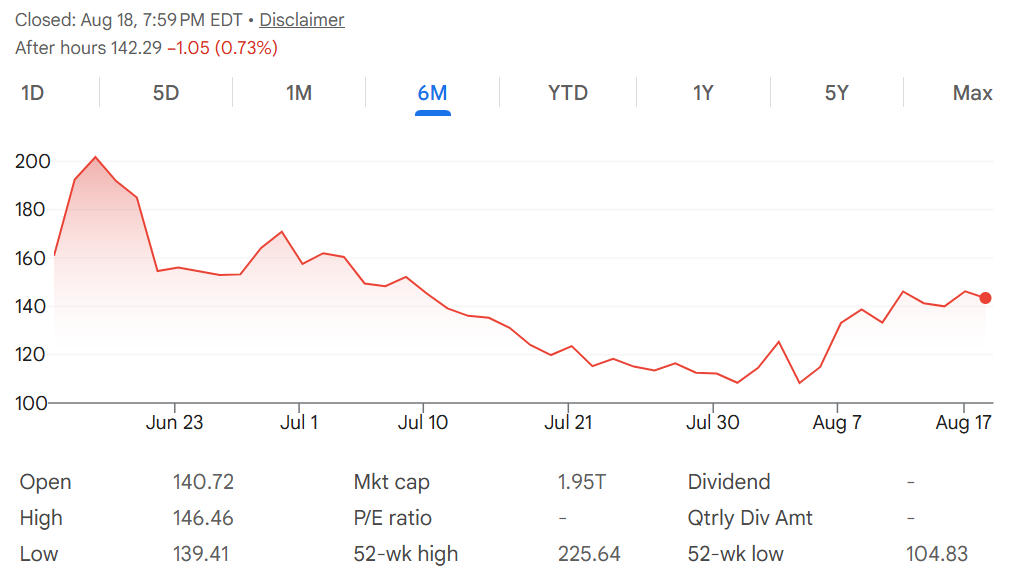
I had been observing this trend for weeks and had the mixture of interest and fear that anyone who has tried to catch a falling knife will know. Everyone who had a microphone was saying something, from “this is the most important company of the decade” to a characterization I saw floating around trading desks that SpaceX was perhaps the single most frothiest and overextended trade in the market anywhere, with the froth spilling over into the valuations of the entire space sector.
Why I Bought Anyway, With The Actual Numbers
Here, I have to be honest, and admit my reasoning, not pretend to have some perfect quantitative model. Under the surface of all the noise, SpaceX’s fundamentals were a completely different story than the stock chart. It wasn’t some pie-in-the-sky idea, it was a business that was making money, actual revenue and actual subscribers, quarter after quarter. Well, that meant I had something to back up, rather than many of the public companies I’d seen that had been all hype and no business.
I bought in around $108 a share around the 3rd of August and I didn’t get the exact bottom, but no one gets the exact bottom and anyone who says they does is either lying or about to lose a ton of money on the next one. I deliberately made the position smaller than I would want to be in my portfolio because I knew that I was buying into a stock that would move about six times more than the market on average, and that’s why I got the position. That’s not a typo. It was an extremely volatile instrument and it would have been a mistake to treat it like a normal equity position size, whatever the trade turned out to be.
The Two Weeks That Followed Were Not Boring is a work of fiction.The Two Weeks That Followed Were Not Boring is a fictional work.
I would like to go through this chronologically, as the actual lived experience of this position was much more eventful than a clean price chart would indicate.
Six days after I purchased in, SpaceX’s first significant insider lockup ended, and a significant portion of eligible shares became available. I had to brace for a sell-off. Rather, and I say this because at the time it caught me off guard, the stock went up about 3% that session, and other space-related companies such as AST SpaceMobile and Rocket Lab followed suit. I had marked this as a real possibility as I went into the trade, but the lockup didn’t cause the dump I was expecting.
Then came August 14th and this was the day that put the most strain on my nerves of any one session in this whole trade. SpaceX beat the market to the punch on the Q2 2026 results, and the actual results were pretty solid. Revenue was $7.8 billion, representing a 92% increase over the year and beating the $6.81 billion consensus. Adjusted EBITDA rose 191% to $3.5 billion despite the reported net loss of $541 million, as the massive scale of investments in infrastructure is responsible for this. Starlink (the Connectivity segment) generated $4.3 billion in revenue and 1.7 million net new subscribers during the quarter. The AI segment, which is still in its early days for the company, had revenue of $2.6 billion, a 247% increase on a year-over-year basis. Management even moved up the estimate of when they will hit a trillion dollars in annualised sales from 2031 to 2026, and they expect the company will be at $100 billion in annualised sales by the end of that year.
On this news, shares jumped 9.43% intraday to $125.33. But the stock then reversed sharply from the highs of the day in the same session by falling 8.56%. I saw all the way through this round trip and I’ll be honest, it was very uncomfortable to watch a position move double digits in both directions in one trading day, on a report that by all fundamental analysis parameters I could find seemed to be a very solid report. That whipsaw is the beta 6.49 statistic, a translation from a number on a data page to an actual felt experience in my stomach.
The same day, Nvidia announced that as of the end of Q2 it held a $21 billion stake in SpaceX, a truly massive endorsement from one of the most closely followed institutional investors in the entire AI and semiconductor industry. It was that one data point, and it was important enough to put my own conviction back on the table, not that I believe retail investors should follow institutional investors blindly, but because it was important enough to put my own conviction back on the table.
The current state of the world as I write this
SpaceX is currently trading around $146, up about 35% to 40% from the low of August 3rd, depending on the intraday moment you look at it. I’m at a very solid unrealized gain of about 30% or so at this point (in less than 3 weeks) at $108 for my own entry. I’m not saying I’ve sold anything, but I’m saying that I want to be clear that I have not sold anything. This is an open position, and this is not a piece about how I won a hand clean, it’s about how I made my decision, while it’s still genuinely up to the player, because that’s the real deal with “buying the dip” and not the sanitized version you hear from somebody who’s telling you about a trade months after it’s all wrapped up.
In front of me is a particular catalyst, one that I need to face squarely. The second, much bigger lockup expires Aug. 20, when an estimated 319 million shares will be released; and the family offices are estimated to be holding somewhere in the ballpark of $3.8 billion in stock going into the expiration date. The initial lockup did not result in the sell off I was worried about. This is a sizeable one, and I can’t say I have any certain idea on how the market will take this kind of supply.
This is a step by step explanation of how I actually made this decision
I believe the process is more important than the outcome here, so I will explain how I thought through this, in case you are making a similar decision for a different volatile that is newly public somewhere down the road.
First, I took out the noises from the basics. The sentiment and positioning of this is discussed by commentary that refers to this as “the frothiest trade ever”, not the underlying business. I actually had to read through the growth and revenue trajectory of a business that Starlink has, if the stock price didn’t move, because a falling stock price on a real growing business is a different situation than a falling stock price on a business that doesn’t have any real revenue underneath the story.
Second, I looked at the size of the position that I wanted to buy, and not the size of the position that I wanted to buy into. If the beta is above 6, then the normal position sizing rules do not apply. This was a small, focused, “let’s do this and see what happens” bet rather than a core position, because if it went up and down in emotion, as it did, it would not have been big enough in dollar terms to really impact my overall financial situation, regardless of how I felt when I made it.
Third, I knew the specific known catalysts before they occurred. I knew there was a first lockup coming. I did know that I would be getting paid. I didn’t know exactly how the market would respond to either, but having the dates ahead of time meant I wasn’t taken aback by news that I didn’t factor into my own expectations, I was watching certain events I knew were going to happen.
Fourth, and this is something I think most retail investors don’t bother with at all, I came up with a list of things that would make me reconsider my opinion. The growth of Starlink subscribers was weak, or if the growth rate of the AI segment had slowed down significantly, it would have been a real thesis-breaking data point for me, not merely a stock price wobble to ride out. It made the actual earnings day a lot easier to sit through, in that I didn’t have to think about my whole thesis as I was going through it, I was just checking against a checklist I already created.
This is the part where I’m honest with you about what could still go wrong
It is not a victory lap as yet, but I don’t want to make it one either, because this is a market where overconfidence gets punished. The August 20th lockup is a genuine and still existing danger right in my face. With the beta number being 6.49, that’s a stock that can lose the gains of the past two weeks as fast as it made them, on news unrelated to the underlying business quality I actually underwrote. I fully realize that “SpaceX acquired xAI” and the rest of the AI infrastructure story behind part of the valuation of this stock is its own execution risk, and it is very difficult to model this with any precision at this early stage of the company’s life as a public company.
There’s one reality of valuing that I have to face, too. Despite the pullback that attracted me to the stock in the first place, I found some independent research that says that SpaceX’s valuation is aggressively high, meaning that it will take years, if not decades, for the company to begin generating earnings worth the market’s valuation. I purchased this stock in anticipation of the fact that the business is worth a price that is significantly lower than it reached in June, rather than the fact that I believe it is currently valued conservatively by any standard.
What I’d Actually Tell Someone Considering The Same Trade Today
If you’re looking at SpaceX right now, sitting around $146, roughly 35% above where I bought it and still meaningfully below its June peak, my honest advice is this. The fundamentals genuinely improved with this last earnings report, the 92% revenue growth and the raised long-term guidance are real, verifiable data points, not marketing spin. But you’re buying after a substantial two-week rally rather than at a genuine capitulation low, and the August 20th lockup sits directly ahead of you as a real, dated catalyst that could go either way based purely on supply and demand dynamics that have nothing to do with the business itself. You can also find more recommended stock lists that I subjectively think are good.
My own position stays open. I’m not adding to it ahead of the lockup, and I’m not trimming it either, because my original thesis, that Starlink’s real revenue growth justified owning this business at a meaningful discount to its June highs, hasn’t been invalidated by anything that’s happened since, it’s actually been reinforced by the Q2 numbers. Whether that conviction ages well past August 20th is a genuinely open question, and I’ll be watching that date as closely as I watched the earnings report, because in a stock with this much volatility baked into its DNA, the next two weeks could just as easily rewrite this entire story as confirm it.