What Costco’s Membership Fee Does to the Valuation Argument
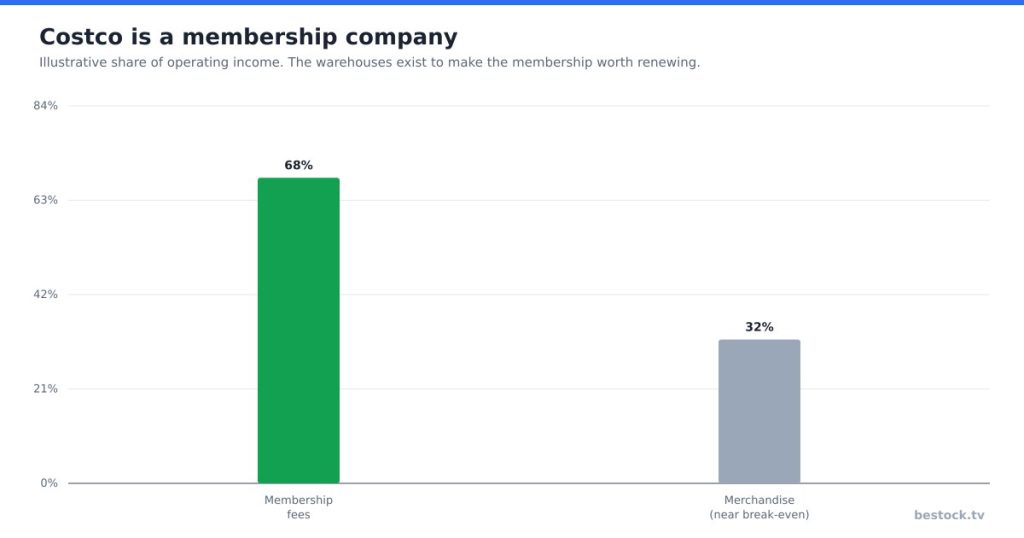
Costco’s membership renewal rate in the U.S. and Canada was 92.2% last quarter, and worldwide it was 89.7%. That number, not the 45.0 times earnings multiple everyone likes to complain about, is the one that tells you whether this business actually works.
The stock’s earnings multiple looks expensive by any normal retail yardstick because retail is the wrong yardstick. Costco’s economics run closer to a subscription business than a store, and once you see that, the price makes more sense.
Here’s what I mean by that, in numbers rather than analogy. In the quarter ended May 10, membership fee income was $1.37 billion, up 10.7%, with about a quarter of that growth coming from the U.S. and Canada fee increase that took effect back in 2024, according to Costco’s own results release. Paid members reached 82.9 million, up 4.1%. Paid executive members, the higher tier that pays more and gets 2% cash back, reached 41.2 million, up 9.6%, growing more than twice as fast as the base membership count.
Why the store barely makes money
Net sales for the quarter were $69.2 billion, up 11.6% from $62.0 billion a year earlier, with comparable sales up 9.8%, or 6.6% once you strip out gasoline price inflation and currency. Those are strong retail numbers on their own. But the retail side of Costco’s business is intentionally run close to break-even, which is why 12.8% gross margin and 4% operating margin over the trailing twelve months look thin next to almost any other retailer worth comparing it to, the kind of comparison I laid out in ranking Costco against TJX, Walmart, Five Below and Ulta.
Membership fee income is nearly pure profit. It costs Costco almost nothing to collect a renewal, and the money drops straight to operating income rather than getting diluted by cost of goods sold. That single line, small relative to $69.2 billion of net sales, accounts for more than half of the company’s operating profit in most quarters. Net income across the trailing year was $8.1 billion, a 3% margin on revenue of $275.2 billion, and that thin-looking margin is exactly what you’d expect from a company that prices merchandise to move it, not to profit from it.
Digitally-enabled comparable sales grew 21.5% in the quarter, or 20.8% adjusting for currency, roughly double the pace of the warehouse business overall. That’s a smaller piece of the total, but it’s growing fast enough that I’d expect it to keep pulling the blended comparable-sales number higher even as in-store traffic growth normalizes.
Three years of revenue, compounding quietly
It’s worth stepping back from the quarter to see the multi-year shape of this. Fiscal 2025 revenue was $275.2 billion, up 8% from $254.5 billion in fiscal 2024, which itself was up from $227.0 billion in fiscal 2022. That’s a company adding tens of billions of dollars in sales every year without a single down year in the stretch, through a period that included a real inflation shock and two different Federal Reserve rate cycles. Costco doesn’t do this by opening warehouses recklessly; it does it by opening a modest, predictable number each year and filling each one with members who keep coming back. The revenue chart looks almost like a bond coupon schedule, which is an unusual thing to say about a retailer.
Three places the fee income can still grow
I see three separate growth levers inside the membership number, and they don’t all depend on the same thing. New member signups is the most obvious one, and it’s a function of new warehouse openings, which Costco controls directly. Renewal rate is the second, and at 92.2% in the U.S. and Canada it is already close to as high as a subscription business gets; there isn’t much room left to improve it, only room to lose it. The third is the mix shift toward executive membership, which at 41.2 million paid accounts and rising faster than the base tier, raises the average fee per member over time without Costco having to raise the sticker price on anyone.
That third lever is underappreciated, in my view. It’s the same idea Walmart has been chasing with its own membership and advertising income, which I wrote about after it became a third of Walmart’s best quarter, except Costco built the model first and has been running it for longer. The difference is that Walmart is retrofitting a subscription business onto a general merchandise base. Costco started there.
The markup cap that never moves
There’s a policy detail that explains why the flywheel keeps turning. Costco caps its own markup at 14% on branded merchandise and 15% on Kirkland Signature private-label goods, a rule that has held since the company’s early years and that management treats as close to inviolate. Most general retailers mark items up 50% or more. Costco gives that margin back to members instead, on purpose, and the result is prices low enough that renewing the membership to keep shopping there is an easy annual decision for most households.
I don’t think this policy is going anywhere. It is the entire value proposition in one number, and touching it would undercut the renewal rate that makes the membership income worth having in the first place. A rival could copy the number on a spreadsheet tomorrow. Actually running a supply chain lean enough to hit it at scale is a different problem, which is why nobody selling groceries or bulk goods has managed to replicate it in three decades of trying.
What forty-five times earnings buys
Costco trades at 45.0 times trailing earnings, against a five-year average of 46.9 and a forward multiple of 41.3 built on expected EPS growth of 9%. That’s not cheap by any conventional measure, and I wouldn’t pretend otherwise. The stock is 18.2% below its 52-week high of $1,095 and 7% above its low of $840, and the average analyst target of $1,084 implies 21% of upside with 68% of covering analysts rating it a buy.
When I want to sanity-check whether a multiple like this is defensible, I run the kind of exercise I described in what a P/E in the mid-30s actually demands from future growth; the same logic applies harder at 45x. The market isn’t pricing Costco on this year’s retail earnings. It’s pricing the durability of a fee stream that has grown for decades without a membership base shrinking through a single recession, including 2008 and 2020. If you believe that durability continues, the multiple is the cost of admission. If you think a serious pullback in discretionary spending finally dents renewal rates, it isn’t.
The trade-down question recessions raise
Here’s my honest uncertainty, and it cuts against the bullish case rather than for it. Costco’s membership base has never been tested by a recession severe enough to make a $65 annual fee, or $130 for executive, feel like a real sacrifice for a meaningful share of members. Every downturn in the company’s history as a public company has instead pushed shoppers toward Costco, on the theory that bulk buying at low markups is where a stretched household trades down to, not away from. I think that theory is probably right. I can’t prove it holds in a scenario materially worse than anything Costco has faced since going public. The specific risk to this call: a renewal rate that falls from 92% toward, say, 88% would flow straight through to the operating income line that carries this whole valuation, and there is no historical quarter I can point to that tells me exactly how far it could slip.
What the options market says before tomorrow’s number
Costco reports fiscal fourth-quarter results tomorrow, September 24. Options pricing has implied an average earnings-day move of 2.1% in recent quarters, a volatility estimate rather than a directional call. The actual move after the last report, in late May, was -3.9%, a decline, which is a useful reminder that a company can beat headline numbers and still see the stock fall if guidance or the renewal-rate trend disappoints. Short interest is a modest 1.7% of the float, so there isn’t a large bearish position that would unwind into a rally on good news; the move tomorrow, whichever direction, will mostly reflect fresh information rather than a short squeeze.
Other valuation checks land close to the P/E read. Price to sales is 1.4, above the five-year average of 1.3 and close to the forward figure of 1.3. Price to book is 12.0, below its own five-year average of 13.3. None of these multiples scream bargain, and none scream bubble either. They describe a stock priced for the membership machine to keep doing what it has done, nothing more dramatic than that, and multiple agreement like this is usually a sign the market has settled on a read rather than argued its way to one.
| Metric | Value | Context |
|---|---|---|
| Price / market cap | $895.31 / $397.1 billion | 52-week range $840-$1,095 |
| Trailing P/E | 45.0 | 5-yr avg 46.9; forward 41.3 |
| Q3 FY2026 net sales | $69.2 billion | up 11.6% year over year |
| Comparable sales | up 9.8% | up 6.6% ex-gas and FX |
| Membership fee income | $1.37 billion | up 10.7%; paid members 82.9 million |
| Operating margin (TTM) | 4% | net margin 3% |
| Analyst target | $1,084 | implies 21% upside, 68% buy-rated |
The number I’m watching first in tomorrow’s release isn’t earnings per share, it’s whether the U.S. and Canada renewal rate held at 92.2% or ticked higher, because that single figure is the leading indicator for every dollar of membership income this valuation depends on. A renewal rate holding steady near 92% keeps the flywheel credible at this price. A print below 91.5% would be the first real crack in an argument that has otherwise held for two decades.
Analysis and opinion only, not investment advice. Figures come from Costco’s fiscal third-quarter 2026 results on SEC EDGAR and Costco’s investor relations site; valuation multiples are approximate and were checked on September 23, 2026.
Related Reading
 CVS
CVS
CVS Stock at 13.6 Times Forward Earnings: Is the Estimate Stale?
CVS Health trades at 23.4 times trailing earnings and 13.6 times forward earnings, and the raised 2026 guidanc…
 News
News
Target Stock: Traffic Is Up 3.6%, Margins Have Not Followed
Target's comparable traffic grew 3.6% last quarter and the stock has nearly doubled from its low. At 16.4 time…
 News
News
Five Footnotes I Read Before I Trust a Balance Sheet
A balance sheet shows totals; the notes show how they were built. Here are the five footnotes I open first, wh…