
Shopify (SHOP): Growth Is Real, but Margin Is Moving the Wrong Way
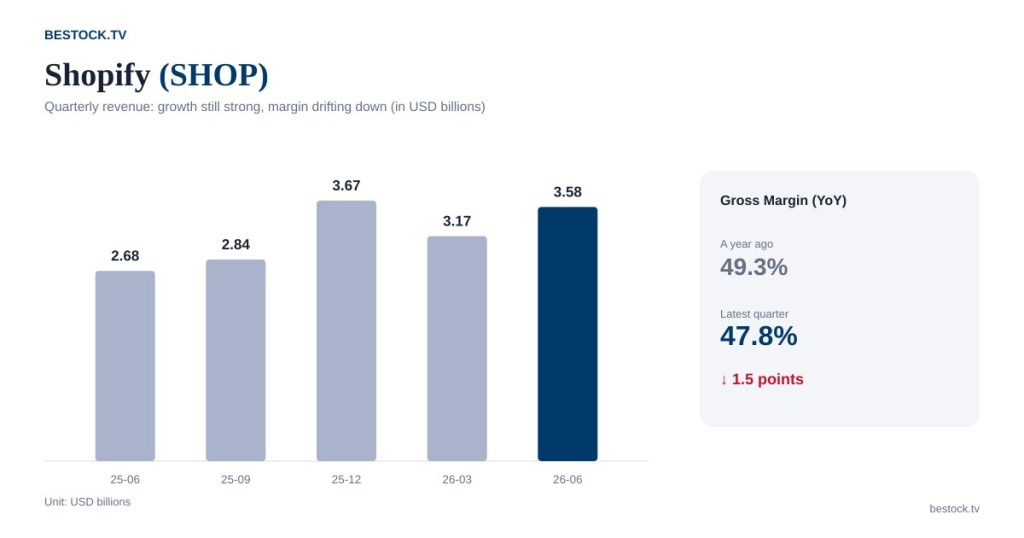
Shopify’s revenue growth has stayed above 30% for five straight quarters, which is the kind of consistency that makes a growth investor relax a little. I don’t relax that easily. The line I actually check before I believe a growth story is gross margin, and Shopify’s has been drifting down for the same five quarters that revenue has been accelerating. Those two trends moving in opposite directions is exactly the setup I look for before I write anything.
The Growth Number Is Real
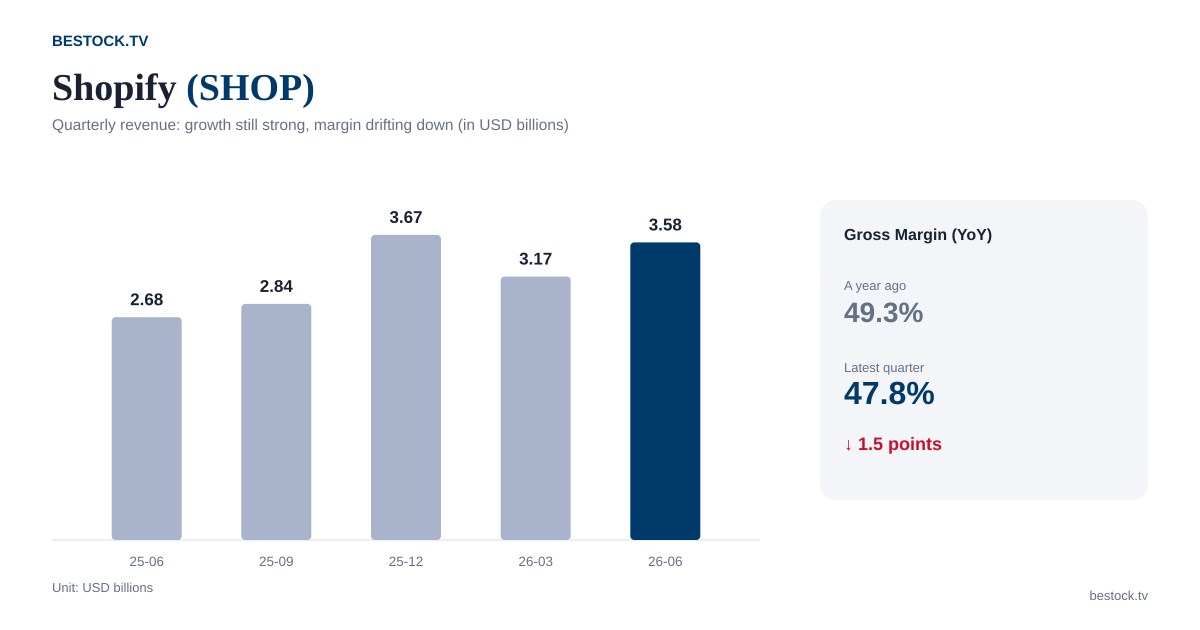
Revenue: $2.68 billion, $2.84 billion, $3.67 billion, $3.17 billion, $3.58 billion, with year-over-year growth of 31.1%, 31.5%, 30.6%, 34.3%, and 33.7% across those same five quarters. That’s about as steady as hypergrowth gets, merchant count and gross merchandise volume both climbing as Shopify keeps winning share from smaller, less integrated e-commerce platforms. I don’t have a reason to doubt the top-line story here.
Margin Is Moving the Wrong Way
Gross margin has slipped from 49.3% a year ago to 47.8% now, a decline of 1.5 points even as revenue growth held up. Shopify’s push into payments processing and its Shopify Fulfillment Network both carry lower margins than the core software subscription business, so as those segments grow as a share of total revenue, blended margin gets diluted even while the underlying software business stays healthy. That’s a mix-shift story, not a pricing-power or competitive problem, which is a meaningfully different risk profile than it would be if the core subscription margin itself were under pressure. I haven’t broken out the subscription-only margin from the filing to confirm that’s the full explanation, so I’m presenting it as my working theory, not a verified fact.
The Valuation Has Priced In the Good Version of This Story
Current P/E (TTM) is 114.5, against a historical average of 64.7, putting the stock at the 80.6th percentile of its own history. Forward P/E drops to 100.2, still a rich multiple by almost any standard outside of hypergrowth software. At this price, the market isn’t just betting on 30%+ revenue growth continuing, it’s betting that margin dilution stays contained rather than compounding as the payments and fulfillment businesses keep scaling.
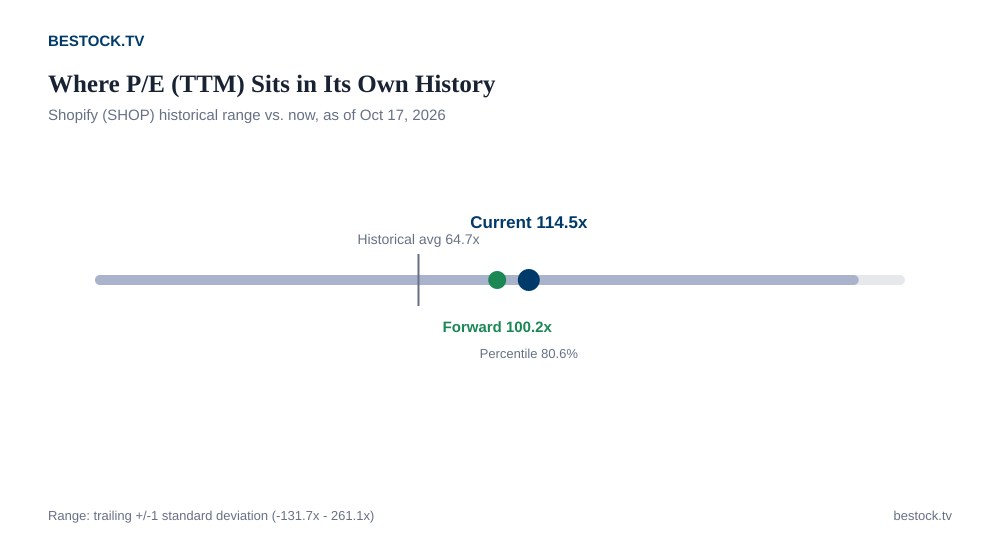
Table: The Numbers Side by Side
| Metric | Value | Context |
|---|---|---|
| Share price | $173.86 | 52-week range $94.00 to $182.19, near the high |
| P/E (TTM) | 114.5 | 80.6th percentile of its own history |
| P/E (forward) | 100.2 | still rich |
| Market cap | $223.7 billion | |
| Dividend yield | 0% | no dividend |
| Analyst rating | 31 analysts, 87% Buy | large sample, strongly positive |
| Average price target | $174.25 | essentially in line with the current price |
That average price target sitting almost exactly at the current share price is the detail I keep coming back to. A 31-analyst panel that’s 87% bullish still isn’t calling for meaningful upside from here, which tells me the sell-side has already given Shopify credit for the growth and isn’t willing to extrapolate further without seeing the margin trend stabilize first.
Where This Breaks, If It Breaks
The specific failure mode I’d watch for isn’t growth slowing, I don’t see evidence of that yet, it’s gross margin dropping below 47% for two consecutive quarters, which would suggest the payments and fulfillment mix shift is compounding rather than stabilizing. At a stock priced for a clean growth story, a margin surprise like that would likely cost more in multiple compression than it costs in actual earnings.
What I’m Doing, and the Number I’m Watching
I’m holding a small position and not adding at this valuation. The number I’m watching next quarter is gross margin, not revenue growth: if it stabilizes anywhere in the 47-48% range, I’ll treat the mix-shift story as contained and consider adding on a pullback. Another full point of decline would push me toward trimming rather than buying more.
Analysis and opinion only, not investment advice. Figures come from the company’s recent filings and our market data snapshot; the valuation percentile comparison is my own calculation.