
Coca-Cola (KO): The Dividend Is Safe, the Price Isn’t Cheap
I own Coca-Cola. I’ve owned it for years, the way a lot of income investors eventually end up owning it almost by accident, because it keeps showing up on every dividend list worth reading. The checks have never missed a beat. What’s changed is the price I’d have to pay to add to that position today, and that’s the part of this stock nobody in my inbox ever asks me about.
The dividend itself isn’t the question here. Coca-Cola has raised its payout for more than six decades running, through recessions, pandemics, and at least two sugar-tax scares that were supposed to end the whole business model. My thesis is narrower: the stock is fine, the dividend is safe, but the valuation has quietly drifted into territory where I’d be buying someone else’s patience, not my own margin of safety.
Growth Came Back This Quarter
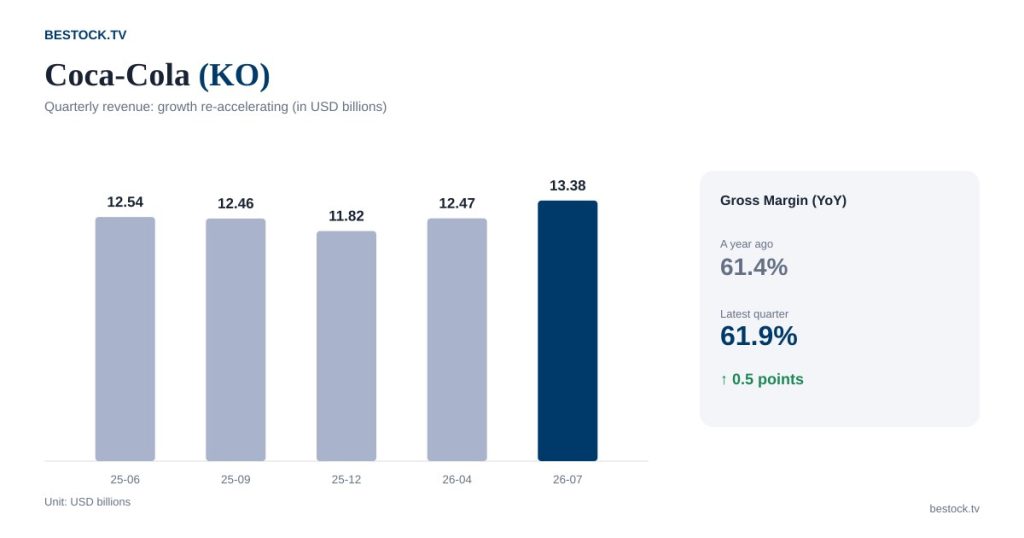
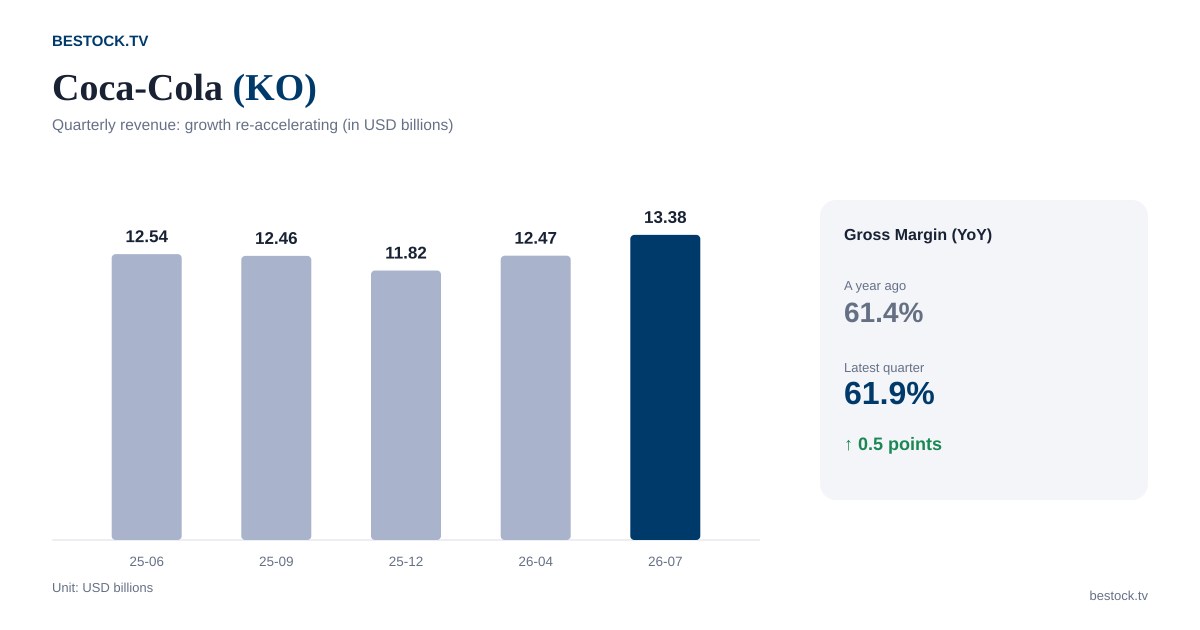
Revenue over the last five quarters ran $12.54 billion, $12.46 billion, $11.82 billion, $12.47 billion, and $13.38 billion, with that last print up 6.7% year over year, the strongest growth in this stretch. Gross margin ticked up to 61.9% from 61.4% a year earlier, a small gain but a real one for a business this size. Concentrate sales, pricing in emerging markets, and a mix shift toward higher-margin categories are doing the work here, not some one-time accounting item I’d need to explain away.
The Four-Year Pattern This Quarter Actually Broke
Zoom out to full fiscal years and a different pattern shows up. Annual revenue growth has been decelerating for four straight years: 11.3% in 2022, 6.4% in 2023, 2.9% in 2024, and just 1.9% in 2025. That’s the backdrop that makes this quarter’s 6.7% growth print worth noticing, it’s the first real break from a multi-year slowdown, not a continuation of it. Net income tells a similar story with a twist: $9.54 billion in 2022, up to $10.71 billion in 2023, essentially flat at $10.63 billion in 2024, then a jump to $13.11 billion in 2025, up 23.3%. Gross margin, meanwhile, has climbed every single year without interruption, from 58.1% in 2022 to 61.6% in 2025.
Put those three lines together and I read it as a company that spent three years managing margin higher while volume growth cooled, and is only now showing the top-line reacceleration that would justify paying up for the stock rather than just admiring the margin discipline from a distance. One strong quarter after four years of deceleration is a meaningfully different claim than “this company has been accelerating,” and I want to be precise about which one I’m actually making.
The Price Has Caught Up With the Story
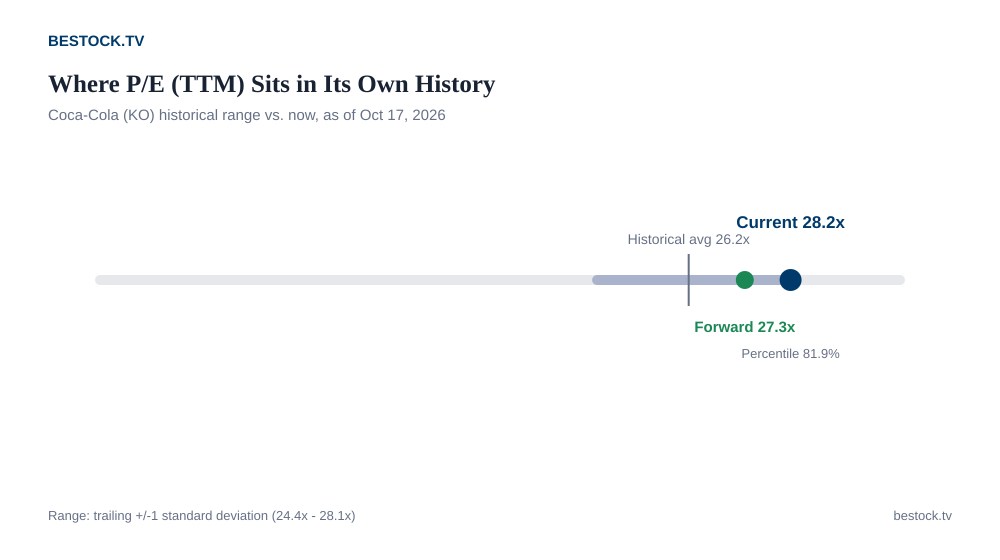
Current P/E (TTM) sits at 28.2, against this stock’s own historical average of 26.2 and a trailing band of roughly 24.4 to 28.1. That puts the valuation at the 82nd percentile of its own history, meaning Coca-Cola has traded cheaper than this most of the time. The stock is also sitting just a few percent below its 52-week high of $94.10, so this isn’t a case of the market panicking into an overreaction. It’s a case of the market paying up for a quietly improving story, and I don’t think that price has much room left for error.
The Risk I’d Actually Point To
More than half of Coca-Cola’s revenue comes from outside the United States, which makes currency translation a real swing factor in reported results that has nothing to do with how many units the company is actually selling. A strengthening dollar converts foreign sales into fewer US dollars on the income statement, something that’s weighed on reported growth in past years even when local-currency sales volumes held up fine. I haven’t broken out how much of this quarter’s growth is currency-neutral versus translation-driven, and that’s a meaningful gap given how much of the business sits overseas.
The competitive backdrop is the other piece worth naming directly: PepsiCo remains a full-scale rival across the same beverage categories, and private-label soft drinks have gotten meaningfully better over the past several years as retailers invest in their own house brands. Neither of those is a new risk, and neither shows up as a specific line item in the numbers I’ve walked through, but they’re the reason I wouldn’t assume Coca-Cola’s pricing power is unlimited just because the last two quarters have looked clean.
The Table: Dividend Numbers That Actually Matter
| Metric | Value | Context |
|---|---|---|
| Share price | $93.78 | 52-week range $65.91 to $94.10 |
| Dividend yield | 2.22% | $2.12 annualized ($0.53/quarter) |
| P/E (TTM) | 28.2 | 82nd percentile of its own history |
| P/E (forward) | 27.3 | barely below TTM |
| Market cap | $403.5 billion | |
| Analyst rating | 17 analysts, 94% Buy | |
| Average price target | $96.67 | about 3% above the current price |
That average target implying only 3% of upside is the detail I’d want you to sit with. Analysts aren’t calling this stock overvalued, but they aren’t calling it a bargain either, and a 94% buy rating paired with almost no implied upside tells me the sell-side has already priced in the good news I just spent two sections describing.
How This Stacks Up Against the Obvious Alternative
PepsiCo is the comparison every Coca-Cola holder eventually has to make, since it’s the closest thing to a direct substitute in both the beverage aisle and an income investor’s portfolio. PepsiCo’s snack food business gives it a different growth and margin profile than Coca-Cola’s pure-play beverage concentrate model, and it’s traded at a discount to Coca-Cola’s multiple for most of the last few years, partly reflecting slower recent snack volume trends. I’m not making a relative-value call between the two here, just noting that if Coca-Cola’s valuation keeps climbing while its own growth story is this early-stage, the gap between the two stocks is worth revisiting rather than assuming it stays constant.
Where I’d Be Wrong
If pricing power keeps running ahead of input cost inflation the way it has the last two quarters, and the emerging-market volume growth holds up through a stronger dollar, this valuation could simply be the new normal for a Coca-Cola that’s finally growing revenue in the high single digits again instead of the low single digits I got used to for most of the last decade. I’m not dismissing that case. I just don’t think it’s proven yet off two good quarters.
What I’m Doing, and the Number I’m Watching
I’m holding what I own and reinvesting the dividend automatically, which I’d do at almost any reasonable price given how durable this payout is. I’m not adding new money at 28 times earnings. The number I’m watching is gross margin: if it keeps climbing past 62% over the next two quarters, I’ll take that as evidence the re-rating is earned and I’ll reconsider adding. If it slips back under 61%, I’ll treat this quarter’s acceleration as the high-water mark, not the new baseline.
I’d also rather be patient than clever here. Dividend compounders like this one punish market-timing attempts more often than they reward them, since the real return comes from decades of reinvested payouts, not from catching a single quarter’s dip. My plan is to keep reinvesting on schedule and revisit the “add new money” question only after I’ve seen a full year of data confirming whether this reacceleration holds, not after one or two good prints.
Analysis and opinion only, not investment advice. Figures come from the company’s recent filings and our market data snapshot; the valuation percentile and gross margin comparisons are my own calculations.